What are ESD workstations and which industries require them for electrostatic discharge protection?
ESD workstations are specialized work surfaces and systems designed to prevent electrostatic discharge damage to sensitive electronic components by maintaining controlled electrical conductivity and grounding paths. These systems are essential in semiconductor manufacturing, electronics assembly, automotive ECU production, aerospace avionics, medical device manufacturing, and precision instrument calibration facilities. Industries handling CMOS circuits, microprocessors, PCB assemblies, and components with voltage sensitivities below 100V require ESD-compliant workstations to meet quality standards and prevent costly component failures during manufacturing and testing processes.
What are the key technical selection criteria for ESD workstation systems including resistance values and surface specifications?
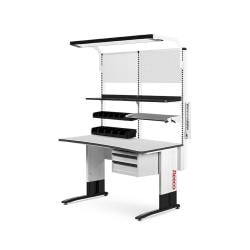
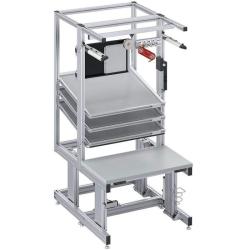
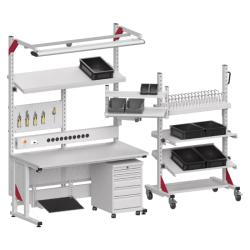
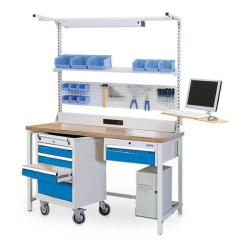
ESD workstation selection requires evaluating surface resistance ranges between 10^6 to 10^9 ohms for dissipative materials and below 10^6 ohms for conductive surfaces, with grounding system resistance maintained under 1 megohm per IEC 61340 standards. Critical factors include worksurface material composition such as laminated dissipative vinyl or conductive rubber, adjustable height ranges typically 720-1080mm for ergonomic compliance, and integrated wrist strap grounding points with 1 megohm current-limiting resistors. The Bosch Rexroth modular systems shown support various configurations with aluminum profile construction and integrated cable management for comprehensive ESD protection across different workspace dimensions and equipment requirements.
Which international standards and certifications apply to ESD workstation design and compliance testing?
ESD workstations must comply with IEC 61340-5-1 for protection of electronic devices from electrostatic phenomena, ANSI/ESD S20.20 for electrostatic discharge control programs, and EN 61340 series standards for electrostatic discharge protection in European markets. Additional relevant standards include JEDEC JESD625 for handling of electrostatic discharge sensitive devices, MIL-STD-1686 for electrostatic discharge control requirements for space systems, and DIN EN 100015 for ESD protective packaging and workstation verification. Regular compliance testing requires surface resistance measurements using calibrated meters per ANSI/EOS/ESD-S11.11 and periodic auditing of grounding system integrity to maintain certification status across production environments.
What are the main differences between modular ESD workstation systems and fixed-configuration alternatives?
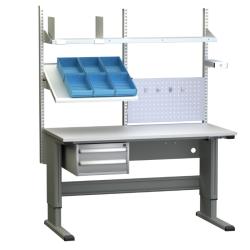
Modular ESD workstation systems like the Bosch Rexroth aluminum profile series offer reconfigurable structures with standardized connection elements, allowing workspace adaptation for changing production requirements and equipment integration without complete system replacement. Fixed-configuration systems such as the Bedrunka+Hirth 8-sided workbench with 736mm depth provide predetermined layouts optimized for specific applications but limited modification capabilities. Modular systems typically feature T-slot aluminum profiles with standard groove dimensions enabling accessory mounting and cable routing flexibility, while fixed systems offer integrated storage solutions like the 7-drawer configuration but require replacement rather than modification when operational needs change.
What installation requirements and system compatibility factors must be considered for ESD workstation deployment?
ESD workstation installation requires verified building ground connections with resistance below 25 ohms, dedicated electrical circuits with isolated grounding conductors, and facility humidity control maintaining 30-70% relative humidity for optimal static dissipation performance. System compatibility involves ensuring worksurface materials match equipment grounding requirements, integrating ionization systems where air movement exceeds 0.5 m/s, and coordinating with facility HVAC systems to prevent static generation from air handling. The modular Bosch Rexroth systems require foundation preparation for profile assembly and coordination with overhead service distribution for power, compressed air, and data connections integrated through the aluminum framework structure.
What safety ratings and environmental operating parameters apply to industrial ESD workstation systems?
Industrial ESD workstations typically operate within temperature ranges of 16-35°C with relative humidity maintained between 30-70% to ensure consistent static dissipation properties and material stability over extended service periods. Electrical safety ratings include low-voltage compliance under EN 60950-1 with current-limiting resistors rated at 1 megohm ±5% tolerance and maximum leakage currents below 0.5mA for personnel protection. Surface materials must maintain consistent resistance values across temperature variations with drift coefficients typically below 10% per 10°C change, while grounding system components require IP20 minimum protection ratings for contamination resistance in industrial manufacturing environments.
What maintenance schedules and inspection requirements ensure long-term ESD workstation effectiveness and compliance?
ESD workstation maintenance requires daily visual inspections of grounding connections and surface cleanliness, monthly resistance testing of worksurfaces using calibrated resistance meters per ANSI/EOS/ESD-S4.1 procedures, and quarterly verification of wrist strap and heel strap functionality with dedicated testers. Annual comprehensive audits must document surface resistance measurements, grounding system continuity testing, and environmental monitoring data to maintain compliance with IEC 61340-5-1 and customer quality requirements. Typical service life expectations range 5-10 years for worksurface materials and 15-20 years for aluminum profile framework components, with replacement schedules based on resistance drift beyond specified tolerances rather than fixed time intervals.