
Proxxon Instruments
Proxxon tools split into two main lines: industrial hand tools (ratchets, socket sets, screwdrivers, torque tools) and Micromot power tools for precision work. Hand tool specialist sets run from 13- to 47-piece cases covering 1/4" to 1/2" drives, while the Micromot line includes corded and 10.8 V cordless tools for drilling, grinding, milling, and polishing. Accessories such as HSS micro-twist drills from 0.3 mm, tungsten-vanadium steel cutters, and diamond grinding pins complement both lines.
Categories
All areas for Proxxon Instruments
Pick an area to see its products and filters.

Advantages
Technical features
The key technical properties at a glance.
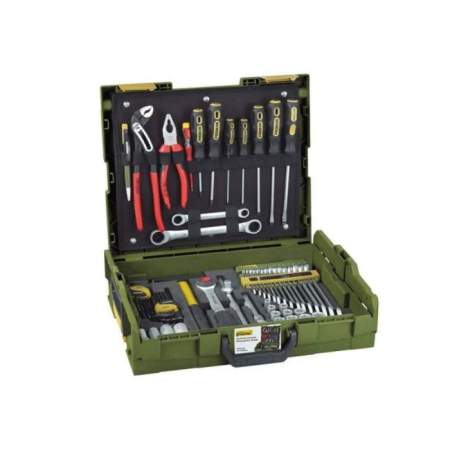
Hand tools: 1/4" to 1/2" drive - workshop special sets 5.5-14 mm (13-pc.) and 13-27 mm (14-pc.)
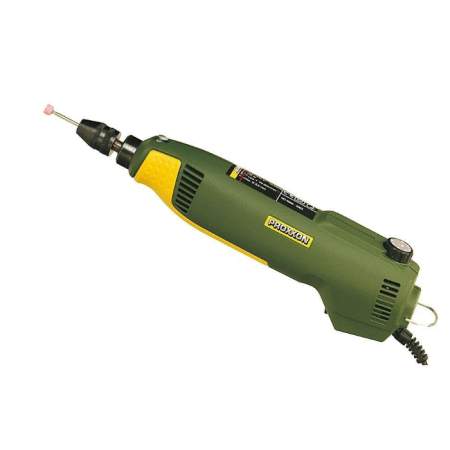
Micromot 10.8 V cordless line - IBS/A drill-grinder, LHW/A angle grinder, BS/A belt sander, WP/A polisher
HSS micro-twist drills from 0.3 mm - DIN 338, 0.3 to 3.2 mm diameter for precision drilling
Tungsten-vanadium steel cutters - cylindrical, ball, conical, and disc cutters, 3.2 mm shank
Universal tool case (23650) - 47-piece, compact plastic case for transport and storage
In detail
Product lines compared
The key data in table form.
| Line | Application | Typical products |
|---|---|---|
| Industrial hand tools | Assembly, maintenance, repair | Socket sets 1/4"-1/2", MicroClick torque driver, ratchets |
| Micromot 10.8 V cordless | Mobile precision machining | IBS/A drill-grinder, LHW/A angle grinder, BS/A belt sander |
| Micromot 230 V / 12 V | Stationary precision work | Handheld drilling machines, lathe and milling systems |
| Insert tools | Machining tasks | HSS drills, W-V cutters, carbide multi-cutters, diamond bits |
Applications
Typical applications
Where these products are typically used.
- industrial assembly and machine maintenance (hand tool sets)
- fine mechanics
- model making
- and prototype development (Micromot)
- electronics and PCB processing (micro-twist drills 0.3-1.6 mm)
- surface finishing and engraving (grinding and polishing tools)
- and repair and service work with compact tooling requirements
FAQ
Frequently asked questions about Proxxon Instruments
What are Proxxon precision instruments and their primary industrial applications?
Proxxon precision instruments are high-accuracy micro tools designed for detailed machining, prototyping, and precision assembly work in manufacturing environments. These German-engineered tools serve automotive component manufacturers, electronics assembly operations, medical device production, and precision engineering workshops requiring tolerances within ±0.01mm. Proxxon rotary tools, micro lathes, and drilling systems enable intricate metalworking on components like injection nozzles, electronic housings, and miniaturized mechanical parts where conventional tooling lacks the required precision control.
What are the key technical selection criteria for Proxxon precision tools?
Proxxon tool selection requires evaluating spindle speed ranges from 5,000 to 20,000 RPM for rotary applications, chuck accuracy within 0.02mm runout tolerance, and motor power ratings between 40W to 100W depending on material hardness. Working envelope dimensions vary from 45mm swing diameter on micro lathes to 150mm throat depth on drill presses, while collet systems accommodate tool shanks from 0.5mm to 8mm diameter. Feed rates, typically 0.01mm to 0.5mm per revolution, must match material removal requirements and surface finish specifications for the intended application.
Which safety standards and certifications apply to Proxxon precision instruments?
Proxxon precision instruments comply with EN 61029-1 safety standards for portable motor-operated electric tools and DIN EN ISO 12100 machinery safety requirements for risk assessment and reduction. CE marking ensures conformity with European Union directives, while VDE testing validates electrical safety for 230V AC operation with Class II double insulation protection. Tools meet EMC Directive 2014/30/EU for electromagnetic compatibility in industrial environments and comply with RoHS 2011/65/EU restrictions on hazardous substances in electrical equipment manufacturing.
What are the differences between main Proxxon tool variants for industrial use?
Proxxon offers distinct tool categories with the PD series micro drill presses providing 0.1mm to 6.8mm drilling capacity with rack-and-pinion feed mechanisms, while DB series bench lathes handle workpieces up to 150mm length with 0.01mm cross-slide resolution. The FET rotary tool line operates at variable speeds from 5,000 to 28,000 RPM with electronic speed control, compared to fixed-speed IBS grinding systems running at 10,000 RPM constant velocity. Each series targets specific machining operations with corresponding chuck systems, motor specifications, and precision requirements.
What installation requirements and system compatibility do Proxxon tools have?
Proxxon precision tools require stable mounting surfaces with vibration isolation, typically secured to workbenches with minimum 50kg mass or dedicated machine stands meeting DIN 876 flatness specifications. Electrical installation demands 230V AC single-phase supply with earth connection, protected by 10A circuit breakers and residual current devices rated at 30mA sensitivity. Tool connectivity uses standard European CEE 7/7 plugs, while accessory mounting employs precision-ground collets with ER11 or proprietary Proxxon chuck systems ensuring concentricity within 0.01mm for optimal cutting performance.
What safety ratings and operating parameters apply to Proxxon precision instruments?
Proxxon precision instruments operate within ambient temperatures from 5°C to 40°C with relative humidity below 85% non-condensing, maintaining accuracy specifications throughout this environmental range. Motors feature IP20 protection against solid objects larger than 12mm diameter, requiring indoor installation in clean workshop environments free from metal chips and coolant exposure. Maximum continuous operation periods range from 15 minutes for high-speed rotary tools at peak RPM to unlimited runtime for bench-mounted lathes under normal cutting loads, with thermal protection circuits preventing overheating damage.
What maintenance schedules and service life expectations apply to Proxxon tools?
Proxxon precision tools require carbon brush inspection every 50 operating hours with replacement at 0.2mm minimum length, while spindle bearings need relubrication with high-speed grease meeting DIN 51825-KP2K specifications every 200 hours. Collet chuck accuracy should be verified monthly using 0.01mm dial indicators, with replacement when runout exceeds 0.02mm tolerance limits. Expected service life ranges from 1,500 hours for rotary tool motors under continuous operation to 5,000 hours for bench lathe headstocks with proper maintenance, assuming compliance with recommended cutting parameters and environmental conditions.