
ESD workstations
Work chairs
Work chairs, stools and sit-stand stools for electronics manufacturing, assembly, laboratories, cleanrooms and medical practices: 1017 models from Bimos, meychair, Grendene, Bedrunka+Hirth, Treston, Warmbier, Bosch Rexroth, Reeco and Throna. Seat heights range from 350 mm for the work table up to 970 mm for standing desks and high workbenches. 269 models are ESD compliant to DIN EN 61340-5-1 and dissipate charges to the floor through the upholstery, mechanism and conductive castors or glides.
Choose where the chair will be used, the working height or the features you need. Each card takes you straight to a filtered selection.
- 1,146 items
- 17 subcategories
- 11 manufacturers
- Net prices plus VAT
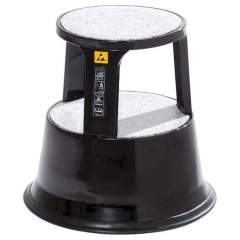
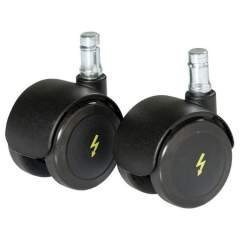
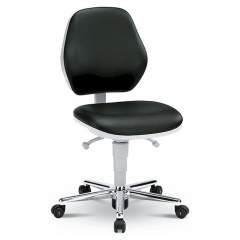
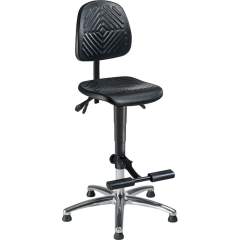
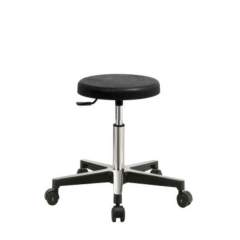
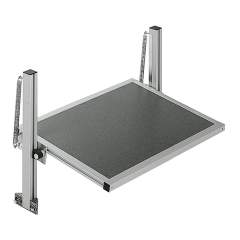
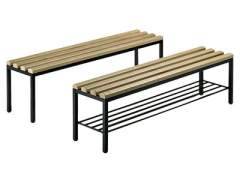


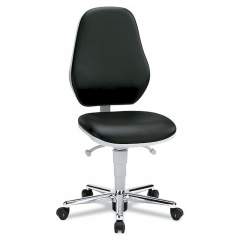
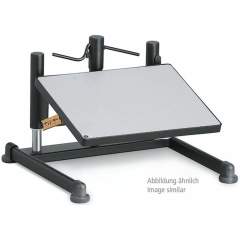
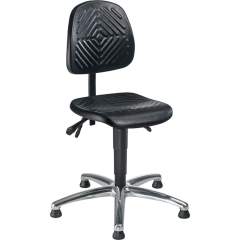
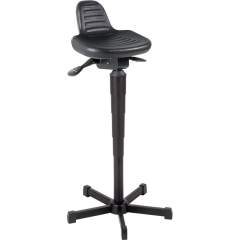
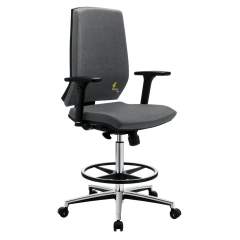
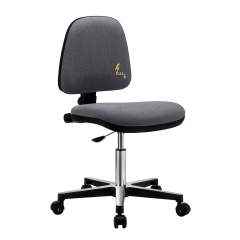
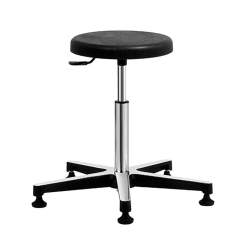
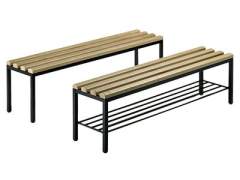

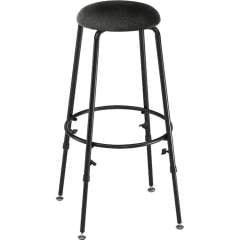

Buying guide
How to choose Work chairs
What matters when choosing: properties, comparison and typical applications.
Choosing the right seat height: working height, foot ring, footrest step
The starting point is the height of the work surface. As a rule of thumb, the seat sits about 280 to 300 mm below the tabletop, so the forearms rest roughly horizontally. What matters is that the required value lies in the middle of the adjustment range, not at the end stop.
| Workstation | Working height | Seat height | Suitable selection |
|---|---|---|---|
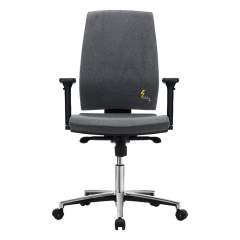
| Assembly table, desk | 720 to 780 mm | 420 to 550 mm | Swivel work chairs |
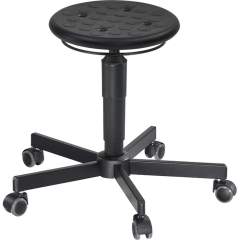
| Lab bench, test station | 850 to 900 mm | 550 to 650 mm | Laboratory chairs, Stools |
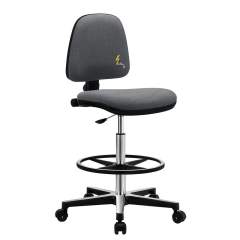
| Standing desk, high workbench, machine | 900 to 1100 mm | 600 to 850 mm | High work chairs |
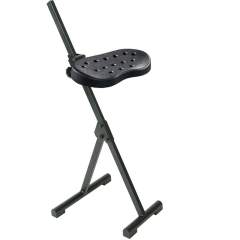
| Mainly standing work | from 950 mm | Perch seat 550 to 900 mm | Sit-stand stools |
From a seat height of about 600 mm, the feet no longer reach the floor. The chair then needs a foot ring or a footrest step, otherwise the front edge of the seat presses into the thighs. At high workstations, glides or self-braking castors are safer than free-running castors: self-braking castors lock as soon as weight is placed on the chair. If the adjustment range is not enough, a footrest makes up the difference.
Seat mechanisms compared
Permanent contact
The backrest stays in contact with the back in every sitting position, and the pressure is set with a handwheel. Simple, robust and well suited to changing users in shift operation.
Models with permanent contactSynchronous mechanism
Seat and backrest move together at a fixed ratio, and the hip angle opens when leaning back. The right choice for long sitting periods, for example at test and screen workstations.
Models with synchronous mechanismWeight adjustment
The backrest counter-pressure adapts to body weight, manually or automatically. Automatic systems save instruction time when several people use the same chair.
Models with weight adjustmentSeat tilt and seat depth
A forward-tilting seat supports assembly work in a forward-leaning posture. Seat depth adjustment adapts the chair to short and long thighs.
Models with seat tilt3D seat dynamics
The seat moves in all directions and keeps the pelvis in motion. Typical of saddle stools for work that alternates between sitting and standing.
Models with 3D seat dynamicsBackrest
Low backrests support the lumbar area and leave the arms free, high backrests and headrests provide relief in a reclined posture. Stools have no backrest or a small wrap-around support.
Models with high backrestUpholstery and materials by application
| Upholstery | Strength | Cleaning | Typical use |
|---|---|---|---|
| Fabric | breathable, comfortable for long sitting periods | vacuum, replaceable cushions on many models | Assembly, office, test station |
| Supertec | microfibre with high abrasion resistance | can be wiped damp | Multi-shift production |
| Artificial leather | sealed surface | can be wiped damp, can be disinfected | Laboratory, medical practice, cleanroom |
| PU foam, Integral foam | seam-free, resistant to oil and chips | washable | Workshop, machine operation |
| Wood (beech) | heat resistant, durable | wipeable | Welding station, workshop, school |
ESD work chairs: dissipation, testing, requirements
In an EPA, the chair is part of the grounding path. Charges flow from the person through the upholstery, mechanism, gas spring and base to the conductive castors or glides and from there through the dissipative floor. For seating, DIN EN 61340-5-1 requires a resistance from the seat surface to the ground point of less than 1 x 10¹⁰ ohms.
Manufacturers in our range
| Manufacturer | Models | Series | Selection |
|---|---|---|---|
| Bimos | 457 | Neon, TEXON, Nexxit, Sintec, Basic, Unitec, Labsit, Allround | View models |
| meychair | 336 | Workster, Assistent, Futura | View models |
| Grendene | 62 | GREF Comfort, Work, Ergonomy | View models |
| Bedrunka+Hirth | 61 | Sit-stand stools, work stools, benches | View models |
| Treston | 29 | Ergo, Plus, Saddle, Flex | View models |
| Warmbier | 26 | Comfort, Economy, Industrial | View models |
| Bosch Rexroth | 24 | Dynamic | View models |
| Reeco | 13 | SOLO, COMFORT-C, PREMIUM-S | View models |
| Throna | 8 | Basic, Comfort, Professional | View models |
| A1-ESD | 1 | ESD step stool | View models |