
ESD workstations
ESD workplaces must meet the surface and system resistance requirements defined in IEC 61340-5-1: a worktop surface resistance of 10⁵-10⁹ Ω and a total system resistance to ground of < 3.5 x 10⁷ Ω are the baseline for any compliant EPA (Electrostatic Protected Area). Height-adjustable frames typically cover a hub range of 720-1,080 mm with lift speeds of 25-40 mm/s and rated load capacities of up to 150 kg, while ESD worktop surfaces use HPL or conductive laminate with a point-to-point resistance verified per IEC 61340-4-1. Structural frames from leading series (Treston, Reeco, Karl Basic/Sintro/Quadro, Bedrunka+Hirth) are engineered for a service life of 10-15 years under continuous production conditions.
esd.equipment brings together ESD workplaces, workstations, chairs, lighting, worktops, dry storage cabinets, and modular assembly technology from established manufacturers - Treston, Reeco, Karl, Bedrunka+Hirth, and Bosch Rexroth - all verified for compliance with IEC 61340-5-1, IEC 61340-5-2, and DIN EN 61340-5-1. The range covers complete EPA fit-out from the ground connection point to the last overhead lamp, giving procurement and EHS teams a single auditable source.
Categories
All areas for ESD workstations
Pick an area to see its products and filters.
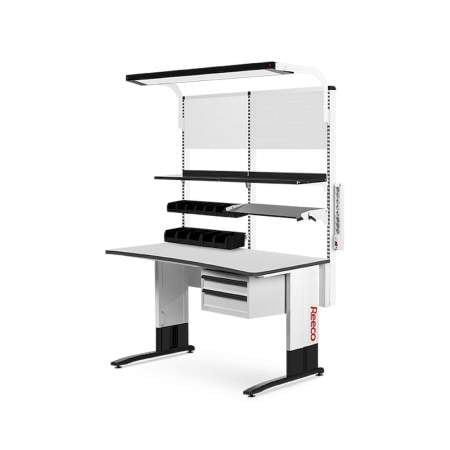 Reeco workstationsCompact ESD tables, steel frame, surface R: 10⁶-10⁹ Ω, load up to 150 kg372 items →
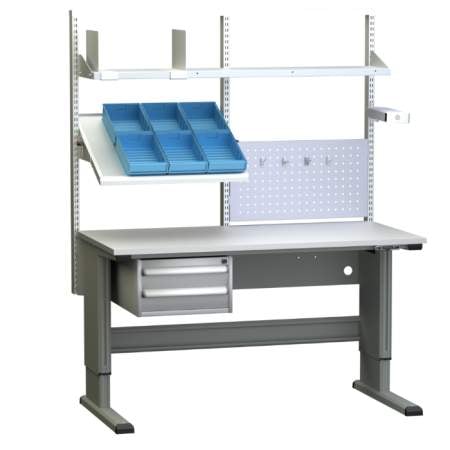 Treston workbenchesModular ESD workstations, height-adjustable frames 720-1,080 mm, R: 10⁵-10⁹ Ω1,666 items →
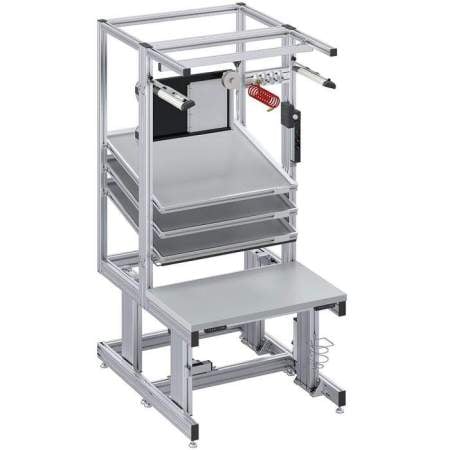 Bosch Rexroth assembly technologyVarioFlow+, TS 2plus, TS 5 transfer systems; aluminium profiles, load up to 300 kg/carrier4,427 items →
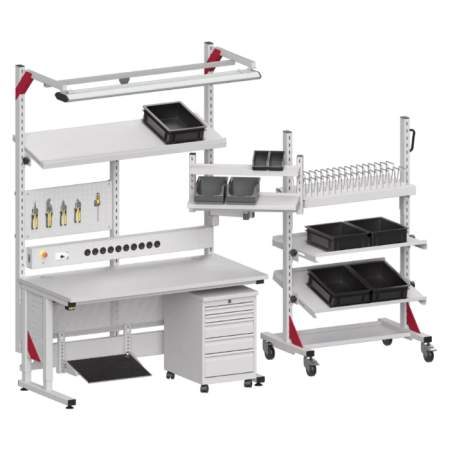 Karl workbenchesBasic, Sintro, Quadro series - cabinet and shelving systems, IEC 61340-5-11,429 items →
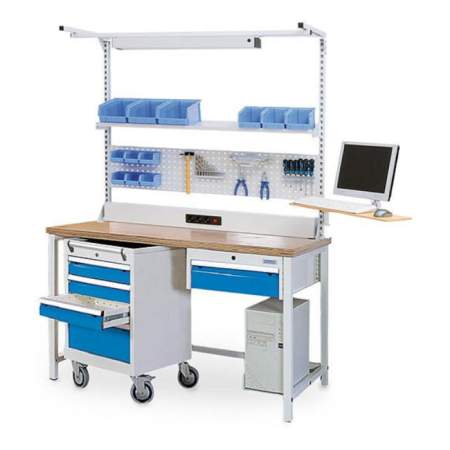 Bedrunka+Hirth workshop equipmentWorkbenches, drawer cabinets, mobile logistics carts - load up to 500 kg2,247 items →
 ListaESD drawer cabinets, workbenches and superstructures with dissipative paint coating1,143 items →
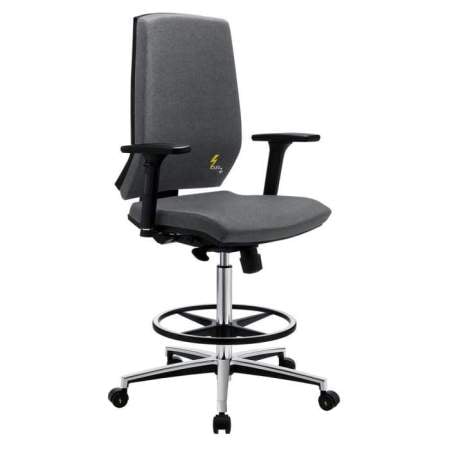 Workplace chairsSwivel chairs, stools, sit-stand stools: ESD, cleanroom, lab, heavy-duty1,146 items →
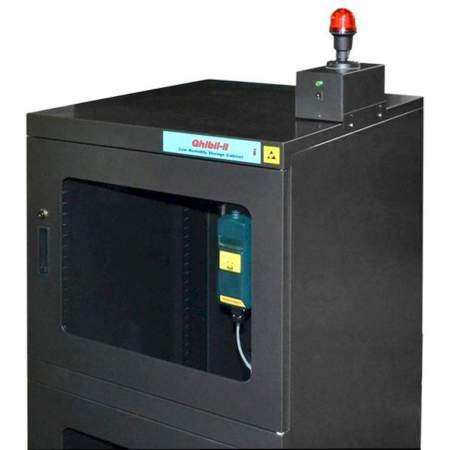 Dry storage cabinetsRelative humidity <5% RH, IPC/JEDEC J-STD-033, MSL 1-6 component storage30 items →
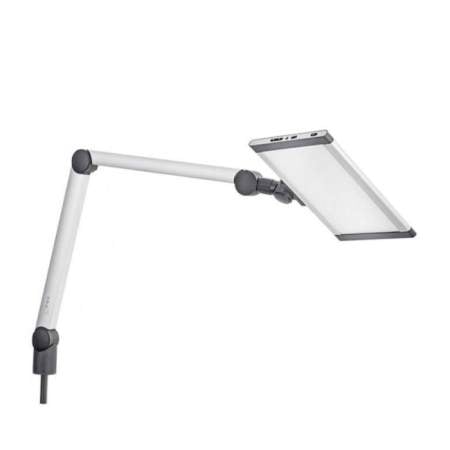 Workplace lightingESD-safe LED luminaires for EPA, antistatic housing, Ra >80, 500-1,000 lx at workplane3,103 items →
 Workstation accessoriesTable tops and spring balancers with rails, trolleys and frames129 items →
Advantages
Key technical advantages
The key technical properties at a glance.
In detail
System comparison & product overview
The key data in table form.
Treston vs. Reeco vs. Karl vs. Bedrunka+Hirth - ESD Workplace Technical Comparison
| Criterion | Treston | Reeco | Karl | Bedrunka+Hirth |
|---|---|---|---|---|
| System concept | Fully modular, configurable add-ons | Compact fixed-format tables | Basic / Sintro / Quadro series | Workbench + cabinet systems |
| Height adjustment | Electric, 720-1,080 mm | Manual crank / fixed | Manual / electric options | Manual crank |
| Rated load | Up to 150 kg | Up to 150 kg | Up to 200 kg | Up to 500 kg |
| Surface resistance | 10⁵-10⁹ Ω (IEC 61340-5-1) | 10⁶-10⁹ Ω | 10⁵-10⁹ Ω | 10⁵-10⁹ Ω |
| Worktop material | ESD HPL laminate, multiple sizes | ESD HPL laminate | ESD HPL / conductive rubber | ESD HPL / steel |
| Superstructure / add-ons | Panels, shelves, drawers, light arms | Limited add-ons | Cabinet and shelving systems | Drawer cabinets, mobile carts |
| Norm certification | IEC 61340-5-1, -5-2 | IEC 61340-5-1 | IEC 61340-5-1, -5-2 | IEC 61340-5-1 |
| Typical application | SMT, rework, inspection, lab | Light assembly, inspection | Storage, assembly, kitting | Heavy assembly, logistics |
Bosch Rexroth Assembly Technology - Product Overview
| Series | Application | Key Specification | Highlight |
|---|---|---|---|
| VarioFlow+ | Chain conveyor for mixed assembly lines | Load up to 300 kg/carrier, speed ca. 0.2-0.5 m/s | Flexible routing, 90 deg curves |
| TS 2plus | Pallet transfer system, light assembly | Pallet 160 x 160 mm - 320 x 320 mm, load up to 15 kg | Compact footprint, ESD-compatible pallets |
| TS 5 | Heavy-load pallet transfer, automotive | Pallet up to 500 x 500 mm, load up to 50 kg | High throughput, robust for 3-shift use |
| Aluminium Profiles | Frame construction, workstation structures | 20 x 20 mm to 80 x 160 mm cross-sections | T-slot system, tool-free assembly |
Applications
Typical applications
Where these products are typically used.
- Electronics manufacturing and SMT rework (IEC 61340-5-1, IPC-A-610)
- semiconductor handling and wafer processing (SEMI S1/S2, SEMI E187)
- medical device assembly under cleanroom conditions (ISO 13485)
- automotive electronics and E/E component production (VDA 6.3, IATF 16949)
- aerospace MRO and avionics assembly (AS9100D)
- and moisture-sensitive device storage at MSL 1-6 (IPC/JEDEC J-STD-033)
FAQ