
How to Measure Dew Point in Compressed Air Correctly
The dew point shows how dry your compressed air really is and whether it meets the humidity class of ISO 8573-1. This guide explains the pressure dew point, how to choose the right humidity sensor and how to calibrate meters in compressed air and drying systems.
To the guidesWhat is the pressure dew point and why does it matter?
The dew point is the temperature at which air becomes saturated with water vapour and condensate forms. In compressed air systems you measure the pressure dew point (PDP), the dew point at operating pressure. It is the key figure for whether moisture will condense in lines, tools or processes.
A PDP of -40 °C means the air only forms condensate again at -40 °C, so it is very dry. Importantly, pressure dew point and atmospheric dew point differ significantly, because the water vapour partial pressure rises with system pressure. The reference pressure must always be stated with the value.
- Refrigerant dryers typically reach +3 to -20 °C pressure dew point.
- Adsorption dryers reach -40 °C to -70 °C pressure dew point.
- Membrane dryers sit between -20 and -40 °C depending on design.
- For frost-exposed outdoor lines at least -25 °C PDP is advisable.
Which humidity class does ISO 8573-1 require?
The standard ISO 8573‑1 classifies compressed air by three contaminants: particles, water and oil. Humidity has its own class scale that defines the maximum pressure dew point. This lets you specify unambiguously how dry a process needs its air to be.
The class is written as a combination, for example ISO 8573‑1:2010 [1:2:1] for particles:water:oil. The middle digit is the humidity figure. A meter must reliably display the required dew point well below its upper range limit.
Which humidity sensor suits my system?
Two technologies dominate dew point measurement in compressed air: capacitive polymer sensors and metal-oxide sensors. For very dry air below -60 °C, chilled-mirror hygrometers are also used as a reference. The choice depends on dew point range, response time and maintenance.
- Always place the measuring point after the dryer and before the consumer.
- Fit oil and particle filters upstream to protect the sensor.
- Ensure sufficient flow, otherwise the reading drifts.
- For intermittent duty, choose sensors with a fast dry-down time.
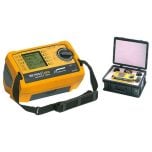
How often must a dew point meter be calibrated?
Humidity sensors drift over time, especially under oil or solvent load. A calibration interval of 12 months is common practice; for critical processes 6 months is advisable. Calibration is done against a traceable reference dew point generator.
- Multi-point calibration across the range you use, not just one point.
- Exchange calibration: fit a calibrated spare sensor and send the original in.
- Keep calibration records for audits for at least one interval.
- After oil contamination check immediately, do not wait for the next interval.
Frequently asked questions
What is the difference between pressure dew point and atmospheric dew point?
The pressure dew point applies at operating pressure, the atmospheric dew point after expansion to ambient pressure. At 7 bar the pressure dew point is roughly 20 to 25 °C higher. Always state the reference pressure.
Which ISO 8573-1 humidity class do I need?
General manufacturing usually needs class 3 (-20 °C), electronics and pneumatic control class 2 (-40 °C), and pharma or semiconductor class 1 (-70 °C). The class defines the maximum permitted pressure dew point.
Which sensor suits very dry compressed air?
For dew points below -60 °C, metal-oxide sensors or chilled-mirror hygrometers are suitable. Capacitive polymer sensors reliably cover the range down to about -60 °C and need less maintenance.
How often is calibration required?
Commonly every 12 months, or every 6 months for critical or oil-loaded processes. Calibration is traceable against a reference dew point generator, ideally as a multi-point calibration.
Looking for the right dew point meter?
Our guide covers capacitive and metal-oxide dew point meters for compressed air and drying systems to ISO 8573-1.
Standards compliant
Measurement matched to the humidity classes of ISO 8573-1.
Traceably calibrated
Certificates with documented measurement deviation.
Wide measuring range
Sensors from -80 to +20 °C pressure dew point.
Selection help
We help you choose the right products; technical details are clarified with the manufacturer.