
Humidity measurement: how do you read relative humidity correctly?
Relative humidity in percent (% rH) is read with a hygrometer or thermo-hygrometer. It is a key value for ESD control, production and material stability. Capacitive sensors now deliver fast digital readings, while dew point and absolute humidity round out the picture.
View measurement toolsWhat is relative humidity and how is it measured?
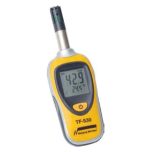
Relative humidity (% rH) states how much water vapour the air holds relative to the maximum possible amount at the current temperature. It is measured with a hygrometer; a thermo-hygrometer also captures temperature, because the two values are closely linked.
Because warm air can hold more water vapour than cold air, relative humidity changes with temperature swings alone, even when the absolute amount of water stays the same. For this reason humidity is almost always reported and logged together with temperature.
Alongside relative humidity, two further quantities are common: the dew point is the temperature at which the air becomes saturated and condensation begins; absolute humidity describes the actual mass of water per cubic metre of air in g/m³. Many thermo-hygrometers calculate these values directly.
Why does humidity matter in production and ESD areas?
Air that is too dry raises the ESD risk because charges dissipate more slowly; air that is too moist promotes corrosion, mould and condensation. A controlled window - typically around 30‑60 % rH in ESD environments - protects components, materials and people.
| Range | Effect | Typical target |
|---|---|---|
| below 30 % rH | increased static charge, ESD risk rises | avoid in the EPA |
| 30-60 % rH | favourable for ESD, comfort and electronics | production target window |
| above 60 % rH | corrosion, condensation and mould possible | review storage carefully |
| 70-90 % rH | clear risk of moisture damage | tolerable only briefly |
In electronics manufacturing humidity matters twice over: it affects static charging at workstations and the shelf life of moisture-sensitive devices (MSD). Comfort and concentration of staff also depend on a balanced indoor climate.
Capacitive, psychrometric, dew point - which principle?
The capacitive sensor is today's standard in digital hygrometers: a moisture-sensitive polymer layer changes its capacitance with humidity, which is read out quickly and stably. The older psychrometric method uses the difference between dry and wet-bulb temperature.
A polymer layer changes capacitance with humidity; fast, digital and low-maintenance - the most common principle.
Compares dry and wetted temperature; robust but slower and dependent on a water wick.
The saturation temperature; important for judging condensation risk on cold surfaces.
 Absolute humidity
Water mass per cubic metre in g/m³; independent of temperature and useful for balances.
On accuracy: good capacitive thermo-hygrometers typically reach ±2‑3 % rH. Calibration is convenient with saturated salt solutions, which create defined humidity values in sealed containers - for example magnesium chloride at about 33 % rH and sodium chloride at about 75 % rH. This lets you check and adjust the reading at two points.
Frequently asked questions
What humidity level makes sense in an ESD area?
In practice a window of roughly 30‑60 % rH is often targeted. Below it static charging rises, above it corrosion and condensation risks grow. The exact target depends on the components and the process.
What is the difference between relative and absolute humidity?
Relative humidity (% rH) relates the water vapour to the maximum possible amount at the current temperature and changes with it. Absolute humidity gives the actual mass of water per cubic metre (g/m³) and is independent of temperature.
How do you calibrate a hygrometer?
The simplest way is with saturated salt solutions in a sealed container: magnesium chloride produces about 33 % rH, sodium chloride about 75 % rH. After a settling time the reading is compared with the target value and adjusted if it deviates.
Find the right hygrometer
From digital thermo-hygrometers to calibration solutions - we help with selection, accuracy and humidity monitoring in your EPA.
Selection help
We help you choose the right products; technical details are clarified with the manufacturer.
Combined units
Thermo-hygrometers capture humidity and temperature in one reading.
ESD focus
Humidity monitoring as a building block of a stable ESD control concept.
Related reading
More on humidity and ESD at /en/ratgeber/humidity-esd-control.