
Ring or Fork Cable Lug - Which One Should You Use?
Ring and fork cable lugs connect conductors securely to terminals and studs. This guide compares both shapes by terminal type, vibration resistance and mounting comfort, and explains how to pick the right cross-section, hole size and insulation.
To the guidesWhat is the difference between ring and fork lugs?
Both lugs form a detachable screw connection between conductor and terminal, but the contact tongue differs. The ring lug fully encloses the stud, while the fork lug (spade terminal) is open on one side and simply slides under the screw.
Because the ring surrounds the stud completely, it cannot come off unless the screw is fully removed. The open fork can be pulled out once the screw is merely loosened, which saves time but is less captive.
When to choose ring, when to choose fork?
The choice depends on terminal type, vibration and mounting comfort. In vehicles, motors and machines with shock loads the ring is standard, while on densely packed terminal blocks and control cabinets the fork wins.
- Ring: battery and ground connections, motors, plants under constant vibration.
- Fork: terminal and spring blocks, frequent rewiring, testing and service work.
- Hole size (M3 to M12) and stud diameter must match the terminal exactly.
- Wire cross-section in mm² sets the colour code: red 0.5‑1.5, blue 1.5‑2.5, yellow 4‑6.
- Choose an insulated lug where touch protection or close spacing is required.
What matters when crimping and tightening?
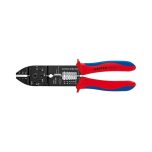
Whether ring or fork, the joint is only as good as the crimp. The wire cross-section must match the barrel, and the crimp tool must hit the window given in the colour code or in mm².
Tightening torque follows the screw size, not the lug. Too little torque raises contact resistance and creates heat, too much deforms the tongue and terminal.
Frequently asked questions
Is a ring lug safer than a fork lug?
Under vibration, yes. The ring fully encloses the stud and can only come off if the screw is completely removed. The open fork is more convenient but less captive.
When should I use a fork lug?
Wherever connections are made and released often, such as on terminal blocks in a control cabinet. You only loosen the screw and pull the lug out sideways.
Which lug do I need for which cross-section?
The colour code shows it: red for 0.5‑1.5 mm², blue for 1.5‑2.5 mm², yellow for 4‑6 mm². The hole size (M3 to M12) must match the terminal stud.
Should a cable lug be crimped or soldered?
Crimping with the right tool is the standard, as it gives a gas-tight, mechanically firm joint. Soldering can make the strands brittle and is unfavourable under vibration.
More on ring and fork cable lugs?
The guide explains the difference between insulated and uninsulated ring and fork lugs and helps with cross-section and hole size.
Vibration-proof
Ring lugs for automotive, motors and plants.
Easy to fit
Fork terminals for fast rewiring.
Colour-coded
Clear match of cross-section and size.
Selection help
We help you choose the right products; technical details are clarified with the manufacturer.