
Push-Pull, Bayonet or Threaded: Which Connector Lock?
The locking system decides whether a connector stays mated under vibration, how fast it installs and how many mating cycles it survives. This guide compares push-pull, bayonet and threaded locking by shock resistance, service life, IP rating and handling.
Browse connectorsHow do the three locking types differ?
The locking mechanism holds the two connector halves together and secures the contact against vibrating loose. With threaded locking a coupling nut is torqued to a defined value, with bayonet locking a quarter turn along a guide slot is enough, and with push-pull the connector latches purely axially by pushing it in.
Each principle strikes a different balance of holding force, speed and space. Threaded gives the highest clamping force and sealing, push-pull the fastest operation in tight spaces, and bayonet sits in between as a rugged compromise.
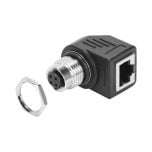 Choosing circular connectors
How to match shell size, pole count and coding to the application.
View productsWhich lock holds up best under vibration?
Under sustained vibration the clamping force is decisive. A coupling nut torqued to spec creates a permanent preload, making threaded locking the safest choice under heavy shaking, for example on motors or in vehicles. Testing usually follows DIN EN 60068‑2‑6 (sine) and -2‑27 (shock).
- Extreme sustained vibration and high temperature: prefer threaded.
- Fast disconnect with moderate vibration: bayonet.
- Confined space, blind mating, many mating cycles: push-pull.
How many mating cycles and which IP rating are possible?
Service life is given in mating cycles - how often the connector can be mated and unmated before contact resistance or the lock degrades. Push-pull systems often reach 5000 cycles or more, threaded 500 to 1000 depending on contact plating.
For high cycle counts the contact surface matters more than the lock: gold-plated contacts last far more cycles than silver- or tin-plated ones. All three types reach their IP rating per DIN EN 60529 provided the seal is seated correctly and - for threaded and bayonet - the end stop is reached.
Frequently asked questions
What does push-pull mean on connectors?
The connector latches when pushed in axially and is released by pulling the outer sleeve. Pulling the cable does not release it, which prevents accidental disconnection within a harness.
Which lock is most vibration-proof?
Threaded locking, because the torqued coupling nut creates a permanent preload. At very high acceleration a thread-locking compound is recommended in addition.
How many mating cycles does a connector survive?
Depending on type and contact plating, 500 to over 5000. Push-pull systems with gold-plated contacts reach the highest figures, threaded usually 500 to 1000.
Does every lock reach IP67?
Yes, all three types are available as IP67. For IP69K and high-pressure washdown, threaded locking is the most reliable choice thanks to its defined seal compression.
The right lock for your application?
Whether push-pull, bayonet or threaded - we supply circular connectors matched to your vibration profile, mating cycles and IP rating.
Standards compliant
IP ratings to DIN EN 60529, vibration to 60068-2-6.
For every profile
Locking matched to vibration and cycle count.
Long service life
Gold-plated contacts for high mating cycles.
Selection help
We help you choose the right products; technical details are clarified with the manufacturer.