
Crimp Quality: How to Run a Pull Test to Standard
A pull test is the fastest way to judge a crimp connection objectively. This guide explains the minimum tensile forces to IEC 60352-2, how to verify the crimp tool setting via crimp height, and which failure modes point to the wrong compression.
View crimp toolsWhat does a crimp pull test actually measure?
A pull test (tensile or crimp pull-off test) draws the contact and the stranded wire apart at a constant speed and records the force at which the joint fails. That value - the pull-off force in newtons - is the objective measure of a crimp connection's mechanical quality.
To IEC 60352‑2 (crimped connections) the sample is clamped in a tensile tester and loaded to failure, typically at around 100 mm/min. The measured force must meet or exceed the minimum tabulated in the standard for the relevant conductor size.
- Pull-off force = force in newtons at which the joint fails.
- Constant test speed, usually 25‑100 mm/min as specified.
- Keep clamping and free wire length reproducible per the standard.
- Always record the conductor size (mm² or AWG) with the result.
What minimum pull force applies per conductor size?
The required pull force rises with conductor cross-section. IEC 60352‑2 sets a minimum for each size that a compliant crimp must reach. The values below show the order of magnitude for common copper strands.
If a sample falls short, the crimp is under-compressed or the wire was damaged. Very high readings combined with severed strands instead point to over-compression.
How do I verify the crimp tool setting?
The pull test judges the result; crimp height controls the process. Crimp height (CH) is the dimension across the crimped ferrule or contact, measured with calipers or a dedicated crimp-height gauge. It is the most reliable indicator that the tool is set correctly.
- Measure crimp height on 3‑5 samples after every tool change.
- Take target and tolerance (often ±0.02 to ±0.05 mm) from the contact datasheet.
- Crimp height too large = under-compressed, wire can pull out.
- Crimp height too small = over-compressed, strands get cut.
- Ratchet tools with a locking mechanism guarantee a full crimp cycle.
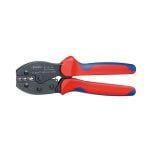 Crimp tools and dies
Calibrated ratchet tools with matching dies for reproducible compression.
View productsWhat do the failure modes tell you?
It is not only the force value that matters, but how and where the joint fails. The break pattern reveals whether the crimp zone, the wire or the tool caused a poor result.
Record force value, conductor size, tool and break pattern for every test. This traceability is the basis of dependable quality assurance to IEC 60352‑2.
Frequently asked questions
Which standard governs the pull test?
IEC 60352‑2 governs crimped, solderless connections. It defines the test setup, test speed and the minimum pull-off forces per conductor size.
How often must I run a pull test?
The pull test is destructive and used as a sample: typically at every tool setup, batch start and at defined intervals. Continuous monitoring is handled by crimp-height measurement.
Does crimp height replace the pull test?
No. Crimp height is the fast, non-destructive process control; the pull test is the objective confirmation of mechanical strength. Together they give a dependable release.
What does an unusually high pull force mean?
Very high values with severed strands indicate over-compression. The wire is cut, reducing long-term strength and current capacity - the crimp height should be corrected.
Crimp and test to standard?
We supply calibrated crimp tools, interchangeable dies and gauges for pull-force and crimp-height control to IEC 60352-2.
Standard-tested
Gauges and methods to IEC 60352-2.
Reproducible
Ratchet tools with locking and crimp-height control.
Traceable
Force values and break patterns fully documented.
Selection help
We help you choose the right products; technical details are clarified with the manufacturer.