
Choosing a Dry-Block Calibrator - What Matters?
A dry-block calibrator generates a defined, stable temperature in a heated metal block and calibrates temperature probes on site. This guide explains how to select a unit by temperature range, stability and homogeneity, and how to match the drilled insert to your probe.
To the guidesHow does a dry-block calibrator work?
A dry-block calibrator uses a metal block brought to a controlled set temperature by heating and, in some models, cooling elements. The probe under test slides into a bore of the changeable insert and is compared against a reference value. This lets you calibrate Pt100 probes, thermocouples and bimetal thermometers on site without a liquid bath.
The internal controller keeps the block temperature constant while a built-in or external reference probe reads the true value. Accuracy hinges on the axial homogeneity along the bore and the radial homogeneity between bores.
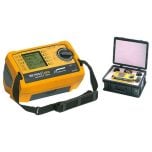 Reference thermometer
How to choose the right reference probe for comparison calibration.
Read the guideWhat temperature range and stability do you need?
The temperature range must cover your probes with some margin. Compact cooled models start around -45 °C, while high-temperature units reach 700 °C. Stability, homogeneity and heat-up time matter just as much.
- Check that the range covers every process set point including safety margins.
- Stability below ±0.05 K gives reproducible readings.
- Short heat-up and cool-down times save real time across many probes.
- Look for at least 150 mm usable bore depth for long probes.
How do you choose the right drilled insert?
The changeable insert transfers heat from the block to the probe. Its bore diameter must match the probe stem: too much play traps an insulating air gap and distorts the reading. As a rule of thumb, keep the radial gap at 0.5 mm or less.
- Multi-bore inserts test the reference and the unit under test at once.
- For thermocouples and thin Pt100, use stepped bores from 3 to 8 mm.
- Clean the bore and probe stem so no debris spoils the contact.
- A custom-machined insert fits non-standard diameters.
Frequently asked questions
Dry block or calibration bath?
Dry blocks are compact, clean and quick to use, ideal on site. Calibration baths offer better homogeneity for short or irregularly shaped probes. For most stem and screw-in probes the dry block is enough.
Do I need an external reference probe?
For low uncertainty, yes. The internal sensor reads the block temperature, while a calibrated reference probe in the same insert captures the real temperature at the device under test and enables comparison calibration.
How deep must the probe be immersed?
As a guide, 15 to 20 times the probe diameter plus the length of the sensitive element, and at least the full working depth of the block, to avoid heat conduction along the stem.
What uncertainty is achievable?
With a good unit, a matched insert and an external reference probe, uncertainties around ±0.2 K are realistic. Without a reference probe, block homogeneity dominates the result.
Looking for the right dry-block calibrator?
Our guide covers dry-block calibrators with matching drilled inserts and reference probes for on-site calibration of your temperature sensors.
Wide range
Units from -45 to 700 °C for every set point.
High stability
Fluctuation down to ±0.02 K for reproducible values.
Matched inserts
Drilled inserts for every probe diameter.
Selection help
We help you choose the right products; technical details are clarified with the manufacturer.