
Inductive or Capacitive - Which Proximity Sensor Fits?
Inductive proximity sensors detect metal only, while capacitive types sense almost any material. This guide compares both by target material, sensing range and environment, and shows how to pick the right type per EN 60947-5-2.
View proximity sensorsHow do inductive and capacitive sensors work?
Both types switch without contact and without wear, but rely on different physics. The inductive proximity sensor generates a high-frequency electromagnetic field at its active face. When metal approaches, eddy currents form and drain energy from the oscillator, triggering the output signal.
The capacitive proximity sensor instead forms a capacitor whose capacitance changes as soon as an object enters the electric field. This detects not only metal but also plastic, glass, wood, liquids and bulk solids. That makes the capacitive type ideal for level detection through thin container walls.
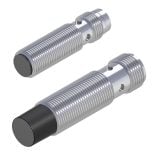
What sets sensing range and flush mounting?
The rated sensing range sn is defined in EN 60947‑5‑2 with a standard steel target (Fe 360, St37). The real assured range sa is only about 0 to 81 percent of sn, since tolerances, temperature and voltage are factored in. Non-ferrous metals reduce the range further via a correction factor.
Mounting style matters too: flush (embeddable) sensors can be recessed into metal but have a shorter range. Non-flush types offer a longer range but need a metal-free clearance zone around the sensor head.
- Factor-1 (full-range) sensors keep the range constant across all metals.
- On capacitive sensors, sensitivity can often be trimmed via a potentiometer.
- Plan a reserve: design with the assured range sa, not with sn.
Which type suits the environment?
The environment drives reliability and service life. Inductive sensors are immune to dust, oil, chips and water and are therefore the standard in machine tools and conveyors. Capacitive sensors are more sensitive to humidity, condensate and build-up, because these also change the capacitance.
Frequently asked questions
Does an inductive sensor detect plastic?
No. Inductive proximity sensors respond only to metals. For plastic, glass, wood or liquids you need a capacitive sensor.
Why is the sensing range smaller with aluminium?
The rated range applies to steel. Non-ferrous metals such as aluminium or copper induce weaker eddy currents, so the range drops via a correction factor to around 35 to 40 percent.
Can a capacitive sensor measure through a container wall?
Yes. With thin, non-metallic walls the capacitive sensor detects the level behind them. Sensitivity is set to the medium via a potentiometer.
What does flush mountable mean?
Flush sensors can be recessed level with the surface of metal and are mechanically protected, but have a shorter sensing range than non-flush versions.
Finding the right proximity sensor?
We supply inductive and capacitive sensors from M8 to M30, flush and non-flush, with PNP/NPN output and IP67 to IP69K.
Standard-compliant
Sensing ranges tested per EN 60947-5-2.
Contactless
Wear-free switching with no mechanical contact.
Wide range
Housings M5 to M30, flush and non-flush.
Selection help
We help you choose the right products; technical details are clarified with the manufacturer.