
Sensing Distance and Flush Mounting - What Matters?
The rated sensing distance decides from how far a proximity sensor switches reliably. This guide explains flush and non-flush mounting, their effect on range and interference immunity, and the clearances required by EN 60947-5-2.
View proximity sensorsContents
What does rated sensing distance mean?
The rated sensing distance sn is the ideal value stated in the datasheet at which a proximity sensor responds to a standard target plate. It applies under laboratory conditions and is not a value you should design with directly.
Several practical figures derive from sn. The effective sensing distance sr accounts for manufacturing tolerances (typically 0.9 to 1.1 x sn), the usable sensing distance su also adds temperature and voltage variation. For safe design the assured sensing distance sa matters, at which switching is guaranteed.
Flush or non-flush mounting?
For inductive proximity sensors the housing type decides whether the sensor may be mounted flush (embeddable) or non-flush (non-embeddable) in metal. Flush sensors carry a metal ring around the active face that focuses the field forward and shields surrounding metal.
- Flush (embeddable): the sensor can sit level with the metal surface without the surrounding material triggering it. The trade-off is a shorter range.
- Non-flush (non-embeddable): larger range up to roughly double the sensing distance, but a clearance zone around the head is mandatory.
- Quasi-flush: a compromise with slight protrusion and moderate clearance requirement.
- Rule of thumb: at the same diameter a non-flush sensor switches about twice as far as a flush one.
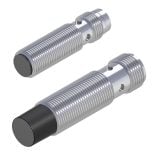 Sensor types compared
Inductive, capacitive or optical - which principle fits your task?
View productsWhich clearances and reduction factors apply?
The sensing distance only holds for the standard target of mild steel (St37/Fe360). Other metals cut the range via the reduction factor. In addition you must respect side clearance, opposing sensors and the free zone so that nearby metal does not switch the sensor by mistake.
- Flush sensors usually need no side clearance, but keep a minimum spacing to the next sensor against mutual interference.
- Non-flush sensors need a metal-free ring around the head, often three times the sensor diameter.
- With factor-1 types the reduction factor is material-independent - handy for mixed materials.
- Set opposing sensors at least twice the sensing distance apart.
How does mounting affect interference immunity?
The mounting type directly affects electromagnetic compatibility. Flush, shielded sensors are less sensitive to lateral metal disturbance and neighbouring fields because the metal ring guides the field. Open, non-flush heads react more strongly to surrounding metal and adjacent sensors.
- Route sensor cables separately from power and motor lines to avoid coupling.
- Keep minimum spacing between sensors so their fields do not overlap.
- Shielded cables and defined grounding reduce interference pulses.
- Choose enough margin to sa so that vibration and thermal drift cause no false switching.
Frequently asked questions
How do flush and non-flush sensors differ?
Flush sensors can be embedded level with metal and are shielded against surrounding metal, but have a shorter range. Non-flush sensors switch further yet need a metal-free clearance around the head.
Why is the assured sensing distance smaller than the rated one?
The rated value applies in the lab on a standard plate. The assured sensing distance sa is at most 0.81 x sn per EN 60947‑5‑2 and holds reserves for tolerance, temperature and ageing.
What is the reduction factor?
It describes how far the range drops for non-ferrous metals. Mild steel gives factor 1, stainless around 0.7, aluminium about 0.4 and copper about 0.3. Factor-1 sensors compensate for this.
How much clearance does a non-flush sensor need?
A metal-free zone should remain around the sensor head, often three times the diameter. Otherwise surrounding metal switches the sensor by mistake.
Looking for the right proximity sensor?
We supply inductive and capacitive proximity sensors in flush and non-flush designs - matched to range, target material and installation.
Standard-tested
Sensors per EN 60947-5-2 with defined sensing distance.
Correctly sized
Advice based on sa and reduction factor, not the rated value.
Flush or non-flush
Both designs available for any installation.
Selection help
We help you choose the right products; technical details are clarified with the manufacturer.