
How do I choose the right digital multimeter?
A digital multimeter measures voltage, current, resistance and continuity, and often capacitance, frequency and temperature. The key selection factors are True-RMS, resolution in counts, accuracy, the CAT safety rating and input protection. This guide walks you through the criteria that matter most.
Explore measurementWhat does a digital multimeter measure?
A digital multimeter (DMM) combines several measurement functions in one instrument. The standard set covers DC and AC voltage, current, resistance and continuity with an audible signal. Many models also measure capacitance, frequency, diodes and temperature, so a single device handles most tasks in electronics and maintenance.
- Voltage (DC/AC): mains, battery and signal voltages
- Current (DC/AC): current draw and load testing
- Resistance and continuity: wiring, contacts, fuses
- Capacitance, frequency, temperature: extended diagnostics
Which criteria decide the choice?
The deciding factors are True-RMS for distorted AC signals, resolution in counts, accuracy in percent, the CAT safety rating and input protection. Auto-ranging saves time, and robust overload protection increases safety. The table below summarises what to look for with each criterion.
Handheld or bench - which suits your work?
Handheld multimeters are portable, rugged and ideal for service, maintenance and field work. Bench multimeters offer higher resolution, more digits and stable references for the lab, calibration and test benches. Your choice depends on mobility, the accuracy required and the nature of the measurement task.
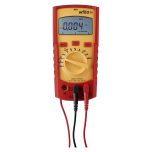 Handheld multimeter
Compact, battery powered and shock resistant for mobile use on site.
View handhelds Bench multimeter
High resolution and stability for the lab, calibration and automated testing.
View bench unitsFrequently asked questions
What does True-RMS mean on a multimeter?
True-RMS stands for true root mean square measurement. Such meters read distorted or non-sinusoidal AC signals correctly, as found on variable frequency drives or switching power supplies. Averaging meters show incorrect values in those cases.
Which CAT rating do I need?
The CAT rating depends on the location: CAT II for outlets and end devices, CAT III for fixed installations and distribution, CAT IV for the utility supply and meters. When in doubt, choose the higher rating with a suitable working voltage.
How many counts should a multimeter have?
For general electronics and maintenance, 6,000 counts is a good benchmark. Higher values give finer resolution and more displayed digits. For precise lab tasks, bench instruments with much higher resolution are appropriate.
Find the right multimeter
Choose the right digital multimeter for your application and the correct CAT rating.
Curated selection
Digital multimeters from established makers for electronics and maintenance.
Safety focus
Instruments with the right CAT rating and reliable input protection.
Selection help
We help you choose the right products; technical details are clarified with the manufacturer.
Reliable delivery
Fast shipping of handheld and bench instruments for your needs.