
How to choose a multimeter for electronics work
A multimeter for electronics has to match the job, not just the price tag. This guide explains the CAT measurement category under IEC 61010, the difference between True-RMS and averaging meters, plus resolution and counts - so you pick the right range safely.
To the guidesWhy does the CAT measurement category define safety?
The measurement category (CAT) under IEC 61010‑1 tells you which overvoltage transients a multimeter can safely withstand in a given part of the mains. It is not a marketing label but the single most important safety figure - a meter rated too low can strike an arc during a transient.
What matters is the CAT level together with the voltage: a CAT III 600 V meter is more robust than a CAT II 1000 V meter, because higher categories are built for higher impulse energy. Pure electronics on a low-voltage bench usually needs CAT II, while mains installation work calls for CAT III.
True-RMS or averaging - which one reads correctly?
Basic multimeters measure the average and scale it to an effective value. That only holds for clean sine waves. As soon as distorted signals appear - behind switch-mode power supplies, variable-frequency drives or LED drivers - averaging meters read well off the true value.
A True-RMS meter computes the real effective value and reads non-sinusoidal AC correctly. In modern electronics with pulse-width modulation and switched supplies this is effectively mandatory whenever AC readings need to be trustworthy.
- True-RMS: correct on distorted signals from switch-mode supplies, drives and dimmers.
- Averaging: reliable only on pure sine, otherwise errors exceeding 40 percent.
- Also check the AC bandwidth in kHz if you measure higher frequencies.
- AC+DC True-RMS captures mixed signals with a DC component fully.
How much resolution and accuracy does electronics need?
Resolution and counts decide how finely the display steps. A 6000-count meter reads up to 5.999, a 60000-count meter up to 59.999 - one digit more. In electronics the fine resolution in the mV and ohm ranges matters most, so you can read small drops and reference voltages cleanly.
Accuracy is stated as a percentage of the reading plus a few digits, for example ±(0.5 % + 2). Service work is fine with 6000 counts and roughly 0.5 % base accuracy; calibration and development tasks justify 50000 counts and ±0.05 %.
Which mistakes end up costing time and money?
Most bad buys happen because people look at the price instead of CAT level, True-RMS and the right ranges. A cheap meter without a µA range is useless for standby-current work, and unfused current jacks are a real hazard.
- CAT level chosen too low for the later working environment.
- No True-RMS even though you measure on switched electronics.
- Missing µA range for standby current and sensors.
- Unfused current jacks without an HRC fuse.
- Thin or non-CAT-rated test leads and probe tips.
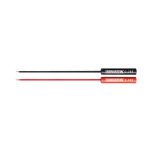 Workshop equipment
Matching test leads, probe tips and accessories for the electronics bench.
Read the guideFrequently asked questions
Which measurement category do I need for electronics?
A low-voltage or outlet bench is usually fine with CAT II. As soon as you measure on fixed installation or distribution, you need CAT III at the right voltage. When in doubt, choose one level higher.
Do I really need True-RMS?
Yes, whenever distorted AC appears, for example behind switch-mode supplies, drives or dimmers. Averaging meters read off there, while True-RMS forms the real effective value correctly.
What do counts mean on a multimeter?
Counts state the maximum display value. 6000 counts read up to 5.999, 60000 counts up to 59.999. More counts mean finer steps, but they do not replace high base accuracy.
Why is the µA range important?
Standby-current and sensor measurements often involve only microamps. Without a fine µA range you cannot resolve that cleanly, which becomes a problem especially with battery-powered electronics.
Looking for the right multimeter?
True-RMS multimeters differ from CAT II to CAT IV, with fine resolution and fused current jacks. Our guides explain how to choose.
Safely rated
Meters per IEC 61010 with clear CAT marking.
True effective values
True-RMS models for switched electronics.
Tested accessories
Test leads with a matching CAT rating.
Selection help
We help you choose the right products; technical details are clarified with the manufacturer.