
Stack-nest containers: nest empty, stack loaded - worth it?
Stack-nest containers combine two functions in one box: rotated 180 degrees they nest inside each other when empty, and aligned they form a stable stack when loaded. This guide shows how much you save versus plain stacking containers, which sizes are common and what to look for when choosing.
To the guidesHow does the stack-and-nest principle work?
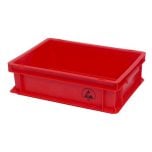
A stack-nest container has tapered walls and a shaped rim. Align two containers the same way and the rims interlock so the boxes stack with full load capacity. Turn the upper one 180 degrees and it slides into the lower one, so both nest and save space.
That is the key difference from a plain stacking container: a classic stacking box needs the same volume whether empty or full. The stack-nest container shrinks to a fraction when empty and makes the return trip cheap.
 Storage & Small Parts
Build your storage and picking area around the right container system.
View productsWhy does the return trip save money?
In a closed loop, containers travel loaded to the recipient and empty on the way back. Plain stacking containers block the full deck space on the return leg. Stack-nest containers nest when empty and cut the volume by 60 to 70 percent depending on the design.
- Fewer truck return runs, because three to four nested boxes take the space of one full box.
- Less floor space tied up by empties in the warehouse and at goods-in.
- Lower transport cost and CO₂ per cycle in a reusable loop.
- Faster handling, as empty containers move as one compact block.
Which sizes and features matter?
Stack-nest containers usually follow the Euro footprint of 600 x 400 mm or 400 x 300 mm, so they sit cleanly on Euro pallets. The material is normally impact-resistant polypropylene (PP), which withstands temperatures from roughly -20 to +80 degrees Celsius.
- Solid walls shield small parts from dust, ventilated walls save weight and let you see the contents.
- Check for a defined nesting height so the empty-state volume gain is actually achieved.
- Smooth interior surfaces and rounded corners make emptying and cleaning easier.
- Label holders or writing areas support picking and traceability.
Frequently asked questions
What sets a stack-nest container apart from a stacking box?
A stacking box only stacks and needs the same space empty or full. A stack-nest container stacks when loaded and nests when empty by turning it 180 degrees, which saves the return transport.
How much volume does nesting save?
Depending on the design, empty volume drops by roughly 60 to 70 percent. Often three to four nested boxes occupy only the space of a single full box.
Which sizes are common?
The Euro footprints 600 x 400 mm and 400 x 300 mm are widespread. They sit pallet-optimised on Euro pallets and fit standard racking.
What material are they made of?
Usually impact-resistant polypropylene. It is available in food-safe grades, easy to clean and holds temperatures from about -20 to +80 degrees Celsius.
Looking for the right stack-nest container?
Stack-nest containers in Euro footprints are nestable when empty for lean return transport and stable to stack when loaded.
Less empty freight
Up to 70 % less return volume in the loop.
Euro grid
600 x 400 and 400 x 300 mm - pallet-optimised.
Two functions
Stacking and nesting in one container.
Selection help
We help you choose the right products; technical details are clarified with the manufacturer.