
Transport containers and KLT bins: which container suits your content, weight and logistics system?
Transport containers and small load carriers (KLT) bundle small parts in standardised grids so they move through shelving, trolleys and conveyors as one unit. With or without a lid, solid or perforated, stackable or nestable and in an ESD version - the choice follows content, weight and logistics system.
View transport containersWhat are transport containers and KLT bins?
Transport containers are stackable plastic bins that group small parts for storage, transport and supply. Small load carriers (KLT) are the standardised version: their footprints follow fixed grids so that bin, shelf, trolley and conveyor all match. Two grids are common - the EURO footprint of 600x400 mm and the VDA-KLT grid.
For electronics manufacturing there are ESD versions made from conductive or dissipative plastic. They drain electrostatic charge in a controlled way and protect sensitive components - matching ESD-safe storage and transport in the EPA. The overview below shows common bin sizes and their typical use.
| Bin type | Footprint | Typical use |
|---|---|---|
| EURO container | 600x400 mm | large parts, order picking |
| EURO container | 400x300 mm | medium parts, half footprint |
| EURO container | 300x200 mm | small parts, open front bin |
| VDA-KLT 4147 | 396x297 mm | paced series logistics |
| VDA-KLT 6147/6280 | 594x396 mm | automotive returnable loop |
| ESD container | various grids | electronics, EPA, charge-safe |
Lids, walls, stackable or nestable - which build fits?
Beyond size, three build features decide suitability: the lid, the wall type and the stacking behaviour. They depend on the content and on the path the bin takes through the logistics system.
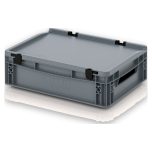 With or without lid
Lids protect the content from dust and access and secure stacked bins. Open bins allow quick reach at the workplace.
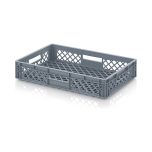 Solid or perforated
Solid walls keep small parts and dirt in. Perforated walls save weight, let air circulate and make the fill level visible.
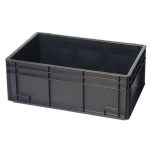 Stackable or nestable
Stackable bins bear load on top of each other. Nestable bins slot into one another empty and save return-transport volume.
Some bins are tapered and therefore both stackable (turned) and nestable - a good compromise when bins return empty. For heavy content, rigid, stack-only bins with a flat base are the safe choice.
How do you choose the right container?
Three questions lead to the choice: what goes in, how heavy will it get and in which logistics system does the bin run? The answers point almost by themselves to grid, build and material.
| Criterion | Question | Effect on the choice |
|---|---|---|
| Content | part size and sensitivity | grid, lid, ESD version |
| Weight | load capacity and stack height | wall thickness, stack-only |
| System | shelf, trolley, conveyor | standard 600x400 footprint |
| Return | empty return or in a loop | nestable saves volume |
Keep to the standardised grid from the start and you can freely combine bins, shelving and trolleys and expand later. For a mixed part range or an ESD requirement on grid, build and material: send us a message.
Frequently asked questions
What is the difference between a transport container and a KLT?
KLT (small load carrier) is the standardised form of the transport container. Its footprints follow fixed grids such as VDA-KLT or the EURO size of 600x400 mm, so that bin, shelf, trolley and conveyor all match.
When do I need ESD containers?
Whenever electrostatically sensitive components are transported or stored, that is in the EPA of electronics manufacturing. ESD containers made from conductive or dissipative plastic drain charge in a controlled way; lids and inserts should come from the same dissipative system.
When is a nestable bin worthwhile?
When bins return empty. Nestable bins slot into one another and save volume on the return trip. If the bin runs filled in a permanent loop, a stack-only bin with higher load capacity makes more sense.
Transport containers and KLT bins for any logistics system
Standardised grids, with or without lids, solid or perforated, stackable or nestable - also in an ESD version for electronics manufacturing.
Standardised
EURO and VDA-KLT grids for gap-free combination.
Reviewed
Content reviewed by storage specialists.
ESD-capable
Dissipative bins and accessories for the EPA.
Selection help
We help you choose the right products; technical details are clarified with the manufacturer.