
How to choose a standing aid for stand-up workplaces
Standing aids and sit-stand stools relieve the back and legs during standing work without giving up the upright working position. This guide explains how to choose one by seat height, seat tilt, base plate and the right relief principle in line with DIN EN ISO 14738.
View standing aidsWhat is a standing aid used for?
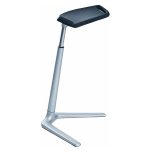
A standing aid is not a chair but a leaning support: the body stays almost upright, the pelvis rests on a slightly tilted seat while the feet keep contact with the floor. Workers move smoothly between standing and leaning, relieving the spine, knees and arch of the foot.
Prolonged standing strains veins and intervertebral discs. Occupational health guidance recommends breaking up pure standing work with dynamic changes of posture. The standing aid keeps the reach and overview of a standing position while taking part of the body weight.
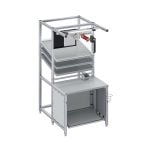 Set up the workplace
How to plan height, reach and freedom of movement at the assembly bench.
Read the guideWhich selection criteria really matter?
The decisive factors are seat height, seat tilt, stability and the adjustment mechanism. Seat height follows the working height: as a rule of thumb the seat sits about 20 to 30 cm below the work surface so that elbows and forearms rest in a relaxed position.
- Seat height infinitely adjustable by gas spring so several workers can share one position.
- Forward-tilted or domed seat opens the hip angle and keeps the back upright.
- Padded or ergonomically shaped seat pan relieves the sit-bone area.
- Height adjustment reachable while seated, without standing up.
Base plate or foot ring - what is stable?
Because a standing aid has only a single column, the base decides on safety. A wide, weighted base plate with a slip-resistant surface does not tip when the worker leans and slides after in a controlled way when standing up.
- Base plate: large contact area, tip-proof, often with a tilt function that follows the movement.
- Foot ring on the column: supports the feet in a higher seating position.
- Choose slip-resistant flooring contact or glides to match the industrial floor.
- For ESD areas use a dissipative version with a verified path resistance.
Frequently asked questions
What is the difference between a standing aid and a sit-stand stool?
A standing aid supports the body while leaning in an almost upright posture. A sit-stand stool additionally allows a higher, perched sitting position with more weight on the seat. Both serve the change between standing and relief.
How do I set the seat height?
As a guide the seat sits about 20 to 30 cm below the work surface so the forearms rest in a relaxed position. Set the height in the real work sequence and correct it if the shoulders ride up.
Does a standing aid replace a work chair?
No. The standing aid is meant for tasks carried out mainly while standing. It breaks up the standing load but does not replace a full seated workstation for longer sitting tasks.
Does a standing aid in an ESD area need a special version?
Yes. In ESD zones the standing aid must be dissipative and connected to the grounding system through glides or castors with a defined resistance in line with DIN EN 61340‑5‑1.
Looking for the right standing aid?
We supply height-adjustable standing aids and sit-stand stools with a tip-proof base plate - also in a dissipative ESD version.
Ergonomic relief
Forward-tilted seat for an upright back during standing work.
Tip-proof
Wide base plate with a slip-resistant footing.
ESD ready
Dissipative version in line with DIN EN 61340-5-1.
Selection help
We help you choose the right products; technical details are clarified with the manufacturer.