
How to choose the right storage bins for small parts
Open-front storage bins keep small parts visible and within reach. This guide shows how to combine sizes, stackability and labelling sensibly and how to match the right shelves to them.
View storage binsWhich bin size fits which part?
Open-front storage bins come in standard sizes, from size 5 (small, roughly 90 x 100 mm) up to size 1 (large, roughly 350 x 500 mm). The open front lets you see and reach the contents without pulling the bin off the shelf. Pick a size that lets the part come out easily and keeps the bin about 70 to 80 percent full.
Bins that are too big waste shelf space and let small parts jumble together, while bins that are too small force constant refilling. As a rule of thumb, put light screws and seals in the small sizes 4 and 5, medium components in sizes 2 and 3, and bulky or heavy items in size 1.
When is stacking better than a shelf?
Stackable storage bins have a solid stacking lip that guides the bin above securely. This builds a compact column on the bench or picking trolley without needing a shelf. Make sure the bottom bins carry the combined load and that the open front stays clear.
- Direct stacking: space-saving for small quantities and mobile work stations.
- Shelves: best access when many different parts are used constantly.
- Wall rails: hung bins free up floor space and stay within reach.
- Check the load rating of the shelf, not just of the bin.
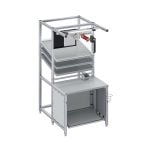
Shelves for small-parts storage should carry a shelf load of at least 100 to 150 kg and adjust in small increments. That lets you match the shelf height to the chosen bin size and use the full height. A back stop keeps bins from sliding off the rear edge.
How do you label bins for the long run?
Clear labelling decides whether a small-parts store works day to day. Use the label pocket on the front face and combine a readable card with a barcode or QR code for booking. Coloured bins or label borders help separate product groups at a glance.
- Printed labels stay legible; marker pen smears and fades quickly.
- A fixed position for the code speeds up scanning noticeably.
- Kanban with two bins per item secures replenishment without counting.
- Label pockets allow swaps without adhesive residue on the bin.
Frequently asked questions
What size should storage bins be?
Choose the size by the part and a fill level of about 70 to 80 percent. Small parts in sizes 4 and 5, medium in 2 and 3, large in size 1. That keeps access easy and shelf space well used.
Are stackable bins or a shelf better?
Stacking suits small quantities and mobile work stations; a shelf suits many different parts with constant access. What matters is that the bottom bins or the shelf carry the total load safely.
How much load does a small-parts shelf carry?
Common shelves carry 100 to 150 kg. Add up the load of all filled bins in the bay and pick a shelf rated above that so it will not sag.
What is the best way to label storage bins?
Best is a printed card in the label pocket combined with a barcode or QR code in a fixed position. A colour code per product group makes sorting easier too.
Looking for storage bins and shelving?
We supply open-front storage bins in every common size, matching load-rated shelves and labelling systems for a well-planned small-parts store.
Every size
From the tiniest part to the largest bin from one source.
Rated load
Shelves with a stated shelf load and reserve.
Cleanly labelled
Label pockets and cards for any system.
Selection help
We help you choose the right products; technical details are clarified with the manufacturer.