What are ESD workstations and which industries require them for electronics manufacturing?
ESD workstations are specialized industrial work surfaces designed to prevent electrostatic discharge damage to sensitive electronic components during assembly, testing, and repair operations. These systems integrate conductive materials, grounding points, and controlled surface resistivity to maintain electrostatic potential below 100 volts according to IEC 61340-5-1 standards. Electronics manufacturers, semiconductor facilities, aerospace companies, automotive ECU production lines, and precision instrument assembly operations require ESD workstations to protect components valued from cents to thousands of euros from invisible static electricity damage.
What technical criteria determine ESD workstation selection for industrial applications?
ESD workstation selection depends on surface resistivity range between 10^6 to 10^9 ohms per square, load capacity requirements, and ergonomic height adjustability typically spanning 720mm to 1080mm. The Bedrunka+Hirth 8-Eck-Werkbank models feature 736mm depth with modular drawer configurations supporting up to 7 drawers per cabinet for component storage. Work surface materials must demonstrate consistent dissipative properties across temperature ranges from 16°C to 35°C while maintaining grounding resistance below 10^9 ohms to effectively drain accumulated charges without creating rapid discharge paths that could damage sensitive ICs.
Which standards and certifications apply to industrial ESD workstation installations?
ESD workstations must comply with IEC 61340-5-1 for protection of electronic devices from electrostatic phenomena, which specifies surface resistance limits and grounding requirements for EPA (Electrostatic Protected Area) establishment. ISO 8570 defines ergonomic requirements for industrial workstations including dimensional tolerances and adjustability ranges. ANSI/ESD S20.20 provides comprehensive program requirements for electrostatic discharge control in manufacturing environments, while DIN EN 100015 covers ESD control procedures for electronic component handling. These standards ensure workstations maintain surface resistivity between 1×10^6 and 1×10^11 ohms and provide reliable grounding paths with resistance below 3.5×10^7 ohms.
How do modular ESD workstation systems differ from fixed configuration models?
Modular ESD workstation systems like Bosch Rexroth profiles enable custom configurations using standardized aluminum extrusions with T-slot connections, allowing height adjustment, accessory mounting, and reconfiguration without specialized tools. Fixed configuration models such as the Bedrunka+Hirth 8-Eck-Werkbank provide predetermined dimensions and drawer arrangements optimized for specific applications but limited modification capability. Modular systems accommodate varying component sizes and workflow changes through adjustable shelving, monitor arms, and tool holders, while fixed systems offer immediate deployment with integrated ESD surfaces and grounding points pre-installed. Both approaches maintain required surface resistivity of 10^6 to 10^9 ohms per square but differ in long-term adaptability and initial setup complexity.
What installation requirements and system compatibility factors affect ESD workstation deployment?
ESD workstation installation requires dedicated grounding connection to facility earth ground with resistance verification below 1×10^6 ohms, typically achieved through 6mm² copper conductors terminated at centralized grounding panels. Power distribution systems must provide isolated ground circuits separate from equipment ground to prevent ground loops that could compromise ESD protection effectiveness. Modular systems utilizing Bosch Rexroth profiles require 40mm×40mm T-slot aluminum extrusions with compatible fasteners rated for static loads up to 500kg per linear meter. Environmental controls maintaining 45-55% relative humidity and temperature stability within ±3°C ensure consistent material conductivity, while facility grounding systems must demonstrate impedance below 25 ohms at test frequencies up to 1MHz according to IEC 61340-5-1 requirements.
What safety ratings and environmental specifications apply to industrial ESD workstations?
Industrial ESD workstations typically maintain IP20 protection rating for standard indoor environments, with surface materials qualified for continuous operation between 16°C to 35°C and relative humidity ranges from 30% to 70% without degradation of electrostatic properties. Conductive work surfaces must demonstrate surface resistance stability within one decade variation across temperature cycling per ASTM D257 testing protocols. Load ratings for industrial applications range from 150kg for basic assembly tasks to 500kg for heavy component handling, with safety factors of 3:1 minimum applied to published capacities. Grounding systems require verification at installation and periodic testing to maintain resistance below 3.5×10^7 ohms, ensuring personnel safety during simultaneous contact with grounded surfaces and charged objects.
What maintenance schedules and inspection requirements ensure ESD workstation effectiveness?
ESD workstation maintenance requires monthly verification of surface resistivity using calibrated resistance meters per IEC 61340-5-1 procedures, documenting measurements between 1×10^6 and 1×10^11 ohms across designated test points. Grounding system continuity testing must occur quarterly with maximum acceptable resistance of 1×10^6 ohms from work surface to facility ground, while visual inspection of grounding straps and connections should be performed weekly. Service life for quality ESD work surfaces exceeds 10 years under normal industrial use with proper cleaning using approved anti-static solutions and avoiding abrasive materials that could compromise surface conductivity. Annual calibration of test equipment and comprehensive EPA auditing ensures continued compliance with electrostatic control program requirements and identifies degradation before critical thresholds are exceeded.
Workplace systems
Workplace Systems Bedrunka+Hirth
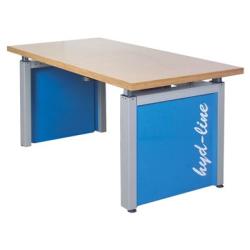
Bedrunka+Hirth Arbeitsplatzsysteme deliver industrial workstations engineered for demanding production and assembly environments - surface resistance values of 10⁵-10¹¹ Ω (DIN EN 61340-5-1) keep ESD-sensitive components protected at every station. The range spans height-adjustable systems from 720 to 1,080 mm, manual and hydraulic lift tables rated to 150 kg, and heavy-duty variants for loads up to 500 kg, all built on powder-coated steel frames with anti-static worktop surfaces.
As an authorised distributor of Bedrunka+Hirth, esd.equipment stocks 365 configurations across 11 product lines - from the modular Workline and Workraster systems to the Hydline hydraulic lift series and the Powerline C and Powerline 4 heavy-load workbenches. All systems comply with IEC 61340-5-1 and DIN EN 61340-5-2 requirements for EPA-compliant workplaces.
Bedrunka+Hirth product line comparison - Arbeitsplatzsysteme
Series
Workline
Powerline C
Powerline 4
Hydline
Frame type
Modular steel
C-frame steel
4-leg steel
Hydraulic steel
Load capacity
150 kg
150 kg
500 kg
150 kg
Height adjustment
Manual / motorised
Manual / motorised
Fixed / manual
Hydraulic stepless
Height range
720-1,080 mm
720-1,050 mm
Fixed or adj.
680-1,080 mm
ESD worktop
Standard (HPL/ESD)
Optional
Optional
Optional
Modular add-ons
Yes - full raster system
Limited
Limited
Limited
Typical application
Assembly, SMT, QC
Assembly, packing
Heavy assembly
Ergonomic stations
Norm compliance
IEC 61340-5-1/-5-2
IEC 61340-5-1
DIN EN ISO 11228
DIN EN ISO 11228
Typical application areas:
Electronics manufacturing SMT lines (IPC-A-610, IEC 61340-5-1), semiconductor back-end assembly (SEMI S1/S2), medical device production (ISO 13485), automotive body and electronics assembly (IATF 16949, VDA 6.3), aerospace maintenance and repair (AS9100), quality control and inspection benches (DIN EN ISO 11228), logistics packing and dispatch stations
This website uses cookies to improve your experience. By clicking “Accept”, you consent to the use of ALL the cookies. However you may visit Cookie Settings to provide a controlled consent.