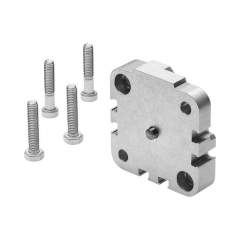
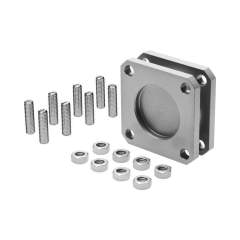
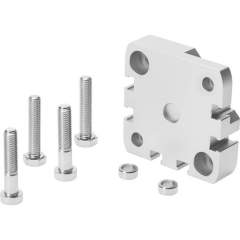
What are Festo tandem cylinders, high-force cylinders, and multi-position cylinders used for in industrial pneumatic systems?
Festo tandem cylinders, high-force cylinders, and multi-position cylinders are specialized pneumatic actuators designed for applications requiring increased force output or multiple discrete positioning capabilities beyond standard single-acting cylinders. Tandem cylinders utilize two pistons in series to double the force output at the same operating pressure, making them ideal for heavy-duty clamping, pressing, and lifting operations in automotive assembly, metal forming, and packaging machinery. Multi-position cylinders like the DPVU and DPNC series enable precise intermediate positioning for complex automation sequences in assembly lines, material handling systems, and robotic work cells where conventional two-position cylinders cannot meet positioning requirements.
What are the key technical selection criteria for Festo multi-position cylinder kits like DPVU and DPNC series?
Selection of Festo multi-position cylinder kits depends primarily on bore diameter, stroke length, operating pressure range, and cushioning requirements for the specific application. The DPVU series covers bore sizes from 20mm to 100mm with operating pressures typically ranging from 1.5 to 10 bar, while DPNC series offers enhanced cushioning for applications requiring smooth deceleration at end positions. Force output scales directly with bore diameter squared, so a DPVU-100 generates approximately 785N at 1 bar compared to 314N for a DPVU-63 at the same pressure. Thread specifications, mounting options, and sensor compatibility must align with existing automation infrastructure and control system requirements.
Which international standards and certifications apply to Festo tandem and multi-position pneumatic cylinders?
Festo tandem cylinders and multi-position cylinders comply with ISO 15552 for interchangeable pneumatic cylinder dimensions and ISO 5598 for fluid power systems terminology and general principles. The cylinders meet EN 983 safety requirements for fluid power systems and components, ensuring proper design margins and pressure vessel compliance. Depending on application environment, units may carry additional certifications such as ATEX directive compliance for explosive atmosphere zones, IP65 ingress protection rating for dust and moisture resistance, and CE marking confirming European conformity. Material certifications often include RoHS compliance for restricted substances and FDA-approved materials for food processing applications where applicable.
What are the main differences between DPVU, DPNC, and DPNA multi-position cylinder series from Festo?
The DPVU series represents Festo's standard multi-position cylinders with basic cushioning and position sensing capabilities, available in bore sizes from 20mm to 100mm for general automation applications. DPNC cylinders incorporate enhanced pneumatic cushioning systems for smooth deceleration and reduced mechanical shock, making them suitable for precision positioning tasks and delicate workpiece handling. DPNA series features advanced position sensing and feedback capabilities with integrated proximity sensors or magnetostrictive position measurement, enabling closed-loop positioning control with repeatability typically within ±0.1mm depending on stroke length and operating conditions.
What are the installation requirements and system compatibility considerations for Festo high-force pneumatic cylinders?
Festo high-force cylinders require compressed air supply filtered to ISO 8573-1 Class 7.4.4 or better, with pressure regulation between 1.5 and 10 bar depending on cylinder specifications and force requirements. Mounting surfaces must provide adequate rigidity to handle reaction forces, typically requiring foundation stiffness at least 10 times the maximum cylinder force to prevent deflection and misalignment. Port connections follow ISO 228 threading standards with sizes ranging from G1/8 to G1/2 depending on bore diameter, and installation clearances must accommodate full stroke plus cushioning overrun distances. Electrical connections for position sensors require IP67-rated connectors and proper cable strain relief to maintain system integrity in industrial environments.
What safety ratings and operating parameters apply to Festo tandem and multi-position pneumatic cylinders?
Festo tandem and multi-position cylinders typically operate within temperature ranges from -20°C to +80°C for standard nitrile seals, with extended temperature variants available for applications requiring operation up to +150°C using fluorocarbon seal materials. Standard units carry IP65 ingress protection rating for the cylinder barrel and IP67 for integrated sensors, ensuring reliable operation in dusty and wet industrial environments. Maximum operating pressure reaches 10 bar for most series with safety factors exceeding 4:1 according to ISO 4414 safety requirements, while proof pressure testing occurs at 1.5 times maximum working pressure. Burst pressure ratings typically exceed 40 bar to ensure safe operation even under pressure surge conditions or system malfunctions.
What maintenance schedule and service life expectations apply to Festo multi-position pneumatic cylinders?
Festo multi-position cylinders require preventive maintenance inspections every 500,000 to 1,000,000 operating cycles depending on application severity, with seal replacement typically needed every 2,000,000 to 5,000,000 cycles under normal operating conditions. Daily visual inspections should verify proper stroke completion, absence of air leakage, and correct sensor functionality, while monthly checks include air supply quality verification and pressure setting confirmation. Seal service life depends heavily on compressed air quality, operating frequency, and ambient contamination levels, with ISO 8573-1 Class 7.4.4 air quality extending seal life significantly compared to unfiltered air supplies. Complete cylinder overhaul or replacement becomes necessary when internal leakage exceeds 10% of supply flow rate or when positioning repeatability degrades beyond application tolerances, typically after 10,000,000 to 20,000,000 operating cycles in well-maintained systems.