
How to choose ESD flooring for the EPA zone?
Dissipative flooring carries charges from people and trolleys safely to ground and is part of every compliant EPA. This guide explains the resistance values in IEC 61340-4-1 and 61340-4-5, compares coverings such as vinyl, PU coating and conductive screed, and shows grounding and testing.
View ESD floorsContents
Why does the EPA need a dissipative floor?
The floor is the largest continuous dissipative surface in an EPA. It drains charges from walking staff, chairs and trolleys and complements wrist strap grounding wherever operators stand or move. The floor is always assessed as a system of person, ESD footwear and covering per EN 61340‑5‑1.
Two standard parts matter: IEC 61340‑4‑1 defines how to measure the electrical resistance of floor coverings, while IEC 61340‑4‑5 evaluates the full person-footwear-floor system through the body voltage generated while walking (the walking test).
 Using wrist straps correctly
When a wrist strap and when a floor-shoe system is the right grounding path.
View productsWhich resistance values must the floor meet?
Two figures are decisive: the resistance to ground Rg (point to earth) and the point-to-point resistance Rp. For an EPA the floor must be dissipative, typically Rg below 10⁹ Ω. In addition, personnel safety usually requires a minimum resistance of 10⁴ to 10⁵ Ω to ground.
- Lower limit for personnel safety: at least 10⁴ to 10⁵ Ω to ground limits the touch current.
- Upper limit for function: below 10⁹ Ω so charges drain away reliably.
- The walking test keeps body charge below 100 V with the combined shoe-floor system.
Which covering suits my application?
The choice depends on load, chemicals and cleaning. Vinyl tiles and sheets are economical and quick to lay, PU and epoxy coatings are seamless and heavy-duty, and conductive screed is the most robust solution for industrial halls.
- ESD vinyl: conductive sheets or tiles bonded with dissipative adhesive over a copper grid.
- PU/epoxy coating: seamless, ideal where hygiene and chemical demands are high.
- Conductive screed: through-conductive, for heavy rolling loads and forklifts.
- Always lay with conductive adhesive and copper grounding tape to the EPA bonding point (EBP).
How is the ESD floor grounded and tested?
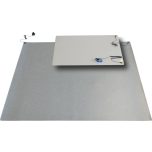
The covering is connected to the protective earth (PE) at the EPA bonding point through a grid of copper tape. After installation the initial test follows IEC 61340‑4‑1, then the floor is measured and documented periodically within the ESD control plan.
- Initial test: Rg and Rp at several points using a defined 5 kg electrode.
- System test: walking test per IEC 61340‑4‑5 with a real ESD shoe.
- Recurring test: at least annually, more often under heavy use.
- Clean only with dissipative ESD care products, never insulating waxes or polishes.
Frequently asked questions
What resistance must an ESD floor have?
The resistance to ground Rg should be below 10⁹ Ω per IEC 61340‑4‑1, yet usually above 10⁴ to 10⁵ Ω for personnel safety. Charges drain reliably while the touch current stays limited.
Is a dissipative floor enough without ESD shoes?
No. The floor only works as a system with dissipative footwear. Without ESD shoes the person is electrically isolated and builds up charge despite a compliant covering.
What is the walking test?
The walking test per IEC 61340‑4‑5 measures the body voltage of a walking person in the person-shoe-floor system. The target is a charge below 100 V.
How often must the ESD floor be tested?
After the initial test the floor is measured recurrently in the ESD control plan, at least annually. More often under heavy use or after cleaning with the wrong products.
Looking for dissipative flooring for your EPA?
We supply ESD vinyl, dissipative coatings and screed systems for dissipative floors, tested to IEC 61340-4-1.
Standard-tested
Coverings assessed to IEC 61340-4-1 and 61340-4-5.
Safely grounded
Copper grounding tape and EBP connection included.
Measurably compliant
Initial and recurring tests documented.
Selection help
We help you choose the right products; technical details are clarified with the manufacturer.