
ESD Grounding at the Workstation - how do I do it right?
An ESD protected area only works when the table, mat, wrist strap and floor share one common potential. This guide shows how to connect every dissipative element to a single earth bonding point per IEC 61340-5-1 and how to test it.
View grounding equipmentContents
Why does every element need one common bonding point?
The goal of any ESD grounding scheme is a single shared potential. Table, mat, wrist strap, floor and grounded tools are all led to the same reference so that no dangerous voltage difference builds up between them. This central connection is called the earth bonding point (EBP).
Under IEC 61340‑5‑1 each element must show a resistance to the ground point below 3.5·10⁷ Ω, so charges dissipate safely but not instantly. The EBP is then connected to the protective earth (PE) of the mains installation.
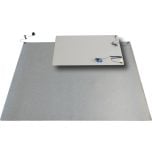
How are the table, mat, wrist strap and floor connected?
Each element gets a defined path to the EBP. The mat via a snap and ground cord, the wrist strap via a coil cord with an integrated 1 MΩ resistor, the floor via grounding plates and its dissipative layer.
- Wrist strap: the 1 MΩ resistor limits touch current and protects the operator.
- Table mat: use its own ground cord, do not earth it through the wrist strap.
- Floor: conductive or dissipative covering with at least two separate grounding plates.
- Route every cable visibly and testably to the shared EBP.
Which resistance values apply and why?
The standard sets two limits: the element resistance to earth and the personnel grounding resistance. Both must stay below 3.5·10⁷ Ω, yet must not be too low for reasons of personal safety.
The 1 MΩ resistor in the wrist strap and ground cord is a compromise: high enough to limit current on accidental contact with voltage, low enough to bleed static charges away within milliseconds.
How is the grounding tested and documented?
An ESD grounding system is only as good as its routine testing. Wrist straps are checked every working day with a tester, while mats and floors are measured periodically against the EBP with a resistance meter.
- Wrist strap: daily test at a tester or continuous monitoring with a constant monitor.
- Table mat and floor: periodic measurement per IEC 61340‑5‑1, record the values.
- Visually inspect snaps, coil cords and ground cables for breaks.
- Have the EBP and PE connection verified at least once a year.
Frequently asked questions
What is a common earth bonding point (EBP)?
The earth bonding point is the central connection where all dissipative elements of an ESD protected area are joined and grounded through the protective earth. This gives every element the same potential.
Why does the grounding include a 1 MΩ resistor?
It limits the current through a person on accidental contact with mains voltage and protects them. Static charges still bleed away fast enough because they do not require high current.
Can the floor replace the wrist strap?
Only when standing or walking with verified ESD footwear and a dissipative floor. When seated a wrist strap is mandatory, because the body is not grounded well enough through the feet.
What is the maximum allowed grounding resistance?
Under IEC 61340‑5‑1 the resistance of each element to earth must be below 3.5·10⁷ Ω. The personnel grounding resistance through the wrist strap shares the same limit.
Building ESD grounding to standard?
We supply earth bonding points, ground cords with 1 MΩ, wrist straps and mats - matched to IEC 61340-5-1.
Standard tested
All components meet IEC 61340-5-1.
One potential
Everything led to a single earth bonding point.
Measurably safe
Resistances documented and testable.
Selection help
We help you choose the right products; technical details are clarified with the manufacturer.