
Choosing ESD flooring: conductive or dissipative?
ESD flooring drains charge from standing and walking people to ground in a controlled way - but only together with dissipative footwear. What counts is the person-shoe-floor system resistance, not the floor alone.
View ESD floorsConductive or dissipative - what is the difference?
Conductive floors (< 106 Ω) drain charge very fast, dissipative floors (106‑109 Ω) more slowly and in a controlled way. ESD work areas usually use dissipative floors because they drain fast enough without forming too low a resistance to the grounding point.
Which limit values and tests apply?
The floor resistance to ground is typically < 109 Ω, the person-shoe-floor system < 3,5×10⁷ Ω. Testing follows several standards:
| Test | What is measured | Standard |
|---|---|---|
| Resistance to ground | floor to grounding point | IEC 61340-4-1 |
| Person-shoe-floor system | draining of a standing person | IEC 61340-5-1 |
| Walking test | charge generated while walking | IEC 61340-4-5 |
Which flooring for which use?
The choice depends on load and space - from a quickly laid floor mat to a permanent floor covering:
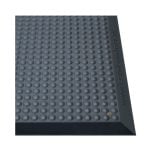
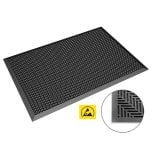
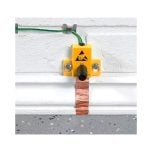
The floor is part of the whole protected area - see Setting up an EPA and the choice of personnel grounding.
Frequently asked questions
Is an ESD floor enough without suitable shoes?
No. Only the interplay of dissipative floor and dissipative footwear (or a heel strap) forms the path to ground. The floor alone does not ground the person.
Conductive or dissipative - which is better?
For ESD areas usually dissipative (106‑109 Ω). Purely conductive floors drain very fast and are intended more for special applications with strict requirements.
How often is the floor tested?
Periodically per the EPA test plan, plus after cleaning or building changes. Cleaning agents can alter the resistance.
The right ESD floor for your area
Floor mats, dissipative coverings and grounding accessories - compliant with IEC 61340-4-1.
Standard-compliant
Floors to IEC 61340-4-1 / 61340-5-1.
Reviewed
Content reviewed by ESD specialists.
Full range
Mats, coverings and grounding accessories.
Selection help
We help you choose the right products; technical details are clarified with the manufacturer.