
Wire Ferrule Colour Code by DIN 46228-4 - which size?
The colour code of insulated wire ferrules follows DIN 46228-4 and assigns a fixed collar colour to each conductor cross-section. This guide gives the full colour table, explains twin ferrules and shows how to avoid mix-ups during assembly.
To the guidesContents
What do ferrules and the colour code do?
Wire ferrules gather the individual strands of a fine-stranded conductor into a solid, gas-tight end. This stops strands from splaying, creates a defined contact area in the terminal and prevents loose connections. On insulated ferrules the coloured plastic collar marks the matching conductor cross-section per DIN 46228‑4.
DIN 46228 has four parts: part 1 covers non-insulated ferrules, part 2 non-insulated corrugated types, part 3 tinned versions, and part 4 insulated ferrules with a plastic collar. Only part 4 defines the colour assignment, which the European CEE 20 recommendation uses in the same sequence.
Which colour matches which cross-section?
Every cross-section from 0.25 mm² to 50 mm² has a fixed collar colour under DIN 46228‑4. The table below lists the most common values with typical collar length - the length also indicates whether it is a short or long version.
- Small sizes 0.25‑1.5 mm²: control and signal wiring, field wiring.
- Medium sizes 2.5‑6 mm²: motor feeders, load circuits in panel wiring.
- Large sizes 10‑50 mm²: incomers and busbar connections.
- Above 50 mm² conductors are usually pressed or bolted rather than crimped.
How do you pick the right ferrule and tool?
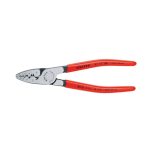
The ferrule must match both the conductor cross-section AND the strip length. Ferrules that are too short grip too little strand; too long, they protrude from the terminal. For two wires in one terminal there are twin ferrules that hold both conductors together and are mechanically more stable than two single ferrules.
How do you avoid mix-ups during assembly?
Mix-ups almost always come from the double assignment of colours or from poor lighting at the workstation. A wrong ferrule leads to excessive contact resistance, heating and, in the worst case, contact failure. A systematic, tidy workstation is the most effective protection.
- Use colour-sorted storage boxes or a ferrule assortment; do not mix loose.
- Separate grey (0.75 and 4.0 mm²) and similar tones physically.
- For every batch read the printed cross-section on the ferrule, not just the colour.
- Provide sufficient glare-free work lighting at the assembly point.
- After crimping do a pull test: the ferrule must not slide off.
Frequently asked questions
Which standard defines the ferrule colour code?
DIN 46228‑4 defines the assignment of collar colour to conductor cross-section for insulated wire ferrules. The European CEE 20 recommendation uses the same colour sequence.
Why do 0.75 mm² and 4.0 mm² both use grey?
The standard's colour palette is limited, so some tones repeat. Grey appears at both 0.75 and 4.0 mm². The ferrules are told apart by size and the printed cross-section.
What is a twin ferrule?
A twin ferrule holds two conductors of equal cross-section in one collar. It is mechanically more stable and saves space compared with two single ferrules in one terminal.
Can I rely on colour alone during assembly?
No. Colour is a quick reference, but because of double assignments and manufacturer tolerances you should always check the printed cross-section on critical connections.
Looking for ferrules and crimp tools?
Insulated wire ferrules to DIN 46228-4 from 0.25 to 50 mm², twin ferrules and matching ratchet crimp tools - more in the guide.
Standard-compliant
Colour code to DIN 46228-4 and CEE 20.
Full range
Cross-sections from 0.25 to 50 mm² available.
Verified crimp
Ratchet tools with lock for a secure crimp.
Selection help
We help you choose the right products; technical details are clarified with the manufacturer.