
Stranded or solid wire - which conductor fits when?
Fine-stranded and solid conductors differ in flexibility, termination and current handling. This guide compares both by flex-life, connection technique and routing, and shows when each construction is the right choice.
To the guidesContents
How do stranded and solid conductors differ?
A solid conductor is a single continuous wire, while a stranded conductor is made of many thin wires twisted together. IEC 60228 (mirrored by DIN VDE 0295) sorts conductors into classes 1 to 6: class 1 is the single solid wire, class 2 the standard multi-wire conductor, and classes 5 and 6 are fine and extra-fine flexible strands.
The higher the class, the more numerous and thinner the individual wires and the more flexible the conductor. The very same cross-section, for example 1.5 mm², can be supplied as a stiff class 1 solid wire or as a highly flexible class 6 strand with hundreds of individual wires.
What about flex-life and routing?
For repeated movement the stranded conductor is clearly superior. Because the stress is shared across many thin wires, a fine class 6 strand survives tens of thousands to millions of bending cycles in drag chains and on robots, whereas a solid wire work-hardens and breaks after only a few flexes.
- Stranded (cl. 5/6): ideal for moving, dragged and frequently re-plugged connections.
- Solid (cl. 1): ideal for a one-time routed, then static installation.
- Mind the bend radius: flexible strands allow much tighter radii than solid wire.
- For drag chains use dedicated continuous-flex strands, not standard connecting leads.
- Solid wire can be shaped and holds its position, an advantage in rigid wiring.
Which termination suits which conductor?
Solid wire plugs straight into screw, spring and push-in terminals because it is dimensionally stable. Fine-stranded wire, by contrast, needs a ferrule in many terminals so the individual wires do not splay, no strands are lost and the contact pressure is spread evenly.
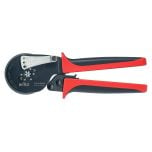
Ferrules are crimped gas-tight onto the stripped strand with a crimping tool. For push-in terminals, ferrules with a plastic collar are common because they guide insertion and insulate. Fine-stranded wire must not go under a plain screw terminal without a ferrule, since the screw crushes individual wires and the contact works loose.
Are there differences in current and handling?
At the same copper cross-section the current capacity of stranded and solid wire is virtually identical, because it depends on the cross-section, not on the number of individual wires. The skin effect only matters at high frequencies and is negligible at mains and control voltages.
- Soldering: solid wire tins easily, stranded should be twisted and lightly pre-tinned before soldering.
- Stripping: with stranded wire use sharp blades so no individual strands are cut off.
- Board work: for header pins on PCBs solid wire is often preferred, stranded for moving leads.
- Cost: solid wire is cheaper, highly flexible strand is dearer due to the elaborate stranding.
Frequently asked questions
Can I clamp fine-stranded wire into a screw terminal without a ferrule?
No, that is not allowed. The screw crushes individual wires, contact pressure is lost and the joint heats up. Fine-stranded wire goes into screw terminals with a ferrule.
Does stranded wire carry more current than solid wire?
No, at the same cross-section the capacity is practically equal, as it depends on the copper cross-section. The advantage of stranded wire is flexibility, not current.
Which conductor suits drag chains?
Highly flexible, extra-fine continuous-flex class 6 strand. Standard connecting leads and solid wire break there quickly under the constant bending stress.
What do conductor classes 1, 2, 5 and 6 mean?
Per IEC 60228 they describe the construction: class 1 single solid wire, class 2 stranded, class 5 fine flexible and class 6 extra-fine highly flexible.
Looking for the right conductor for your application?
Fine-stranded wire, flexible connecting leads and solid wire plus ferrules and crimping tools are matched to your routing - more in our guides.
Standard compliant
Conductor classes per IEC 60228 / DIN VDE 0295.
Fully crimpable
Ferrules and crimping tools from one source.
Correctly terminated
Advice on terminals and connection.
Selection help
We help you choose the right products; technical details are clarified with the manufacturer.