
Twin ferrules: when are two conductors in one terminal OK?
Twin or double ferrules bundle two conductors inside one sleeve, creating a single gas-tight pin for one terminal. This guide explains when that is permitted under DIN 46228-4, how to pick the right size and how to crimp it correctly.
To the guidesContents
What is a twin ferrule and when do I need one?
A twin ferrule is a wire-end ferrule with a wide plastic collar and a larger metal barrel that holds two fine-stranded conductors at once. Both wires are crimped together into a single, dimensionally stable pin for one terminal.
The classic use case is looping a potential through: for example carrying a supply voltage from one terminal to the next when only one connection point is available. Instead of forcing two bare wires into a terminal, the twin ferrule bundles them cleanly.
- Looping L, N or PE through DIN-rail terminals.
- Bridging two conductors when no jumper is provided.
- Combining two control wires onto a single terminal.
- Extending an existing wiring installation afterwards.
When are two conductors in one terminal permitted?
Twin ferrules are standardised in DIN 46228‑4 and designed for two conductors of the same cross-section. Double occupancy is permitted when the ferrule, the crimp tool and the terminal are all rated for it and the combined cross-section suits the terminal.
- Not allowed: two wires of different cross-section in a standard ferrule.
- Not allowed: mixing one bare and one ferruled wire in the same terminal.
- Not advised: more than two conductors - use a potential distributor or jumpers instead.
How do I size and crimp the right twin ferrule?
The key marking is 2 x cross-section, for example 2 x 0.75 mm² or 2 x 2.5 mm². The collar colour follows the DIN colour code, so the size is visible at a glance. Both wires are stripped to the same length and pushed into the barrel together.
Crimping uses a plier that covers the required nominal range - usually 0.25 to 16 mm². A good tool presses with a four-indent or trapezoidal profile and has a ratchet lock that only releases once full crimp force is reached. This produces a gas-tight, permanently low-resistance joint.
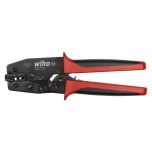 Choose a crimp tool
See which crimping plier fits which cross-section in our tool guide.
View productsWhich mistakes occur in practice?
The most frequent faults come from the wrong size, unequal conductors or a poor crimp. A loose or over-pressed ferrule causes contact resistance, heating and, in the worst case, contact failure under load.
- Two different cross-sections combined - the crimp becomes uneven.
- A standard ferrule misused instead of a twin - the barrel is too tight.
- Not stripped to equal length - one wire sits deeper than the other.
- Wrong crimp position or a worn plier - no gas-tight joint.
Frequently asked questions
Can I clamp two wires into one terminal without a ferrule?
Only if the terminal maker expressly approves double occupancy. For fine-stranded wires the standardised twin ferrule to DIN 46228‑4 is the safe route, because both conductors are pressed into one defined, gas-tight pin.
Must both conductors have the same cross-section?
Yes. Twin ferrules are designed for two equal cross-sections, e.g. 2 x 1.5 mm². Different sizes cause an uneven crimp and an unreliable joint.
Which tool do I need for twin ferrules?
A ferrule crimping plier with a four-indent or trapezoidal profile that covers the doubled cross-section. A ratchet lock matters so full crimp force is reached in one stroke.
How do I identify the right size?
By the 2 x cross-section marking and the DIN collar colour, for example black for 2 x 1.5 mm². Both wires should slide easily into the metal barrel.
Looking for twin ferrules and the matching tool?
Insulated twin ferrules to DIN 46228-4 come in all common cross-sections, plus matching crimping pliers with a ratchet lock for a gas-tight joint.
Standard-compliant
Twin ferrules to DIN 46228-4 with DIN colour code.
Gas-tight crimp
Four-indent and trapezoidal press for lasting contact.
All cross-sections
Available from 2 x 0.5 up to 2 x 16 mm².
Selection help
We help you choose the right products; technical details are clarified with the manufacturer.