
Choosing shelving: load, dimensions and design?
Shelving stores cartons, bins and small parts on several levels. What matters is the load per shelf and per bay, the right dimensions and the design as a bolted or boltless system. Matching load, size and finish to the task sets up a store or workplace safely and flexibly.
View shelvingHow much load capacity does the shelving need?
Two figures count: the shelf load per shelf and the bay load as the sum of all shelves in a bay. The shelf load sets what one shelf carries; the bay load caps the total per bay. The maker states both values - plan with a reserve and spread the load evenly.
| Class | Shelf load | Use |
|---|---|---|
| Light | up to approx. 100 kg | cartons, folders, small parts |
| Medium | approx. 100-250 kg | bins, tools, stored goods |
| Heavy | from approx. 300 kg | machine parts, heavy loads |
Which dimensions and design fit?
The dimensions come from width, depth and height in mm. Width follows the stored goods, depth the bin size and height the room height and reach. For the design there are two systems: the bolted rack is robust and stable, the boltless rack assembles fast without tools.
| Design | Assembly | Use |
|---|---|---|
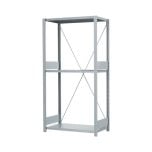
| Bolted rack | bolted, high stability | permanent storage, heavy loads |
| Boltless rack | plug-together, no tools | flexible setup and rebuild |
| Base / add-on bay | row on shared uprights | continuous shelving runs |
For active picking where stock rolls forward, a different principle fits - see Choosing a flow rack.
Which finish and ESD variant do I need?
The finish protects the shelving and adapts it to the surroundings. Galvanised is robust and corrosion-resistant for store and workshop; powder-coated gives a closed, decorative surface. In electronics manufacturing an ESD / dissipative variant lets charge drain in a controlled way and keeps sensitive components safe.
Frequently asked questions
What is the difference between shelf load and bay load?
The shelf load is the capacity of a single shelf, the bay load the permitted total of all shelves in a bay. The bay load is usually lower than shelf load times the number of shelves - always check both figures.
Bolted or boltless rack - which is better?
The bolted rack is especially stable and suits heavy permanent loads. The boltless rack assembles without tools and is quick to set up and rebuild - ideal for flexible storage.
When do I need ESD shelving?
In electronics manufacturing and inside the EPA. A dissipative variant drains charge in a controlled way and is bonded to the earthing system so that sensitive components stay protected.
The right shelving for store and workshop
Bolted and boltless racks in matching dimensions and load ratings, galvanised, powder-coated or in ESD form - with notes on shelf load, bay load and row layout.
Reviewed
Content reviewed by workplace specialists.
Clearly sized
Shelf load and bay load matched to the task.
ESD variants
Dissipative shelving for electronics manufacturing.
Selection help
We help you choose the right products; technical details are clarified with the manufacturer.