
Choosing Shelving: Boltless or Bolted Construction?
Shelving units are the backbone of small parts and archive storage. This guide explains how to size the shelf load per level, the number of shelves and the bay load, and whether a boltless or a bolted system suits your application.
View shelving unitsWhich load ratings actually matter?
Two figures decide whether a shelving unit fits: the shelf load per level and the bay load per unit. The shelf load states how much a single shelf may carry when the weight is evenly distributed, the bay load is the total of all shelves plus self-weight between two frames.
Small parts storage often manages with 80 to 150 kg shelf load, because many light bins are spread over many shelves. Archive and file storage needs 120 to 250 kg, since a running metre of binders weighs around 50 to 60 kg and adds up quickly.
How many shelves and what height make sense?
The number of shelves determines how finely you divide the storage space. Shelves adjustable on a 25 mm pitch let you match the compartment height to bins or binders and avoid wasting air.
As a rule of thumb, allow about 33 cm clear height for A4 binders, and 20 to 35 cm for stackable storage bins depending on size. A standard height of 2000 mm comfortably holds 5 to 7 shelves.
- Compartment height adjustable on a 25 mm pitch for flexible layouts.
- Binder storage: plan about 33 cm clear height per level.
- Heavy shelves at the bottom, light ones on top for a low centre of gravity.
- Add-on bays share a frame and save material and floor space.
- Heights above 2500 mm only with impact protection and a stability check.
Boltless or bolted construction?
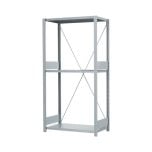
Boltless shelving is joined with clips or keyhole slots without tools and can be assembled and reconfigured in minutes. Bolted shelving is connected rigidly with brackets and bolts and carries higher loads at the same profile thickness.
For a small parts store that is often rearranged, the boltless system is usually the better choice: quick to extend, no bolts, ideal for changing ranges. For a permanent archive or heavy spare parts, the bolted construction shows its strengths, because it offers higher shelf loads and greater rigidity.
Frequently asked questions
What is the difference between shelf load and bay load?
The shelf load applies to a single shelf with an evenly distributed weight. The bay load is the permissible total load of all shelves in one unit between two frames. Both values must match your range.
How many shelves do I need for a binder archive?
Allow about 33 cm clear height per binder row. At 2000 mm height that usually gives 5 to 6 shelves, each rated 120 to 250 kg shelf load.
Is a boltless unit as stable as a bolted one?
For light to medium loads yes, especially with a cross brace on the back. For high shelf loads from about 250 kg or permanently heavy goods, the bolted construction is stiffer and stronger.
Does a shelving unit need to be secured against tipping?
Free-standing or tall units from about 2000 mm should be tied to the wall or joined via top ties. Keep heavy shelves at the bottom to hold the centre of gravity low.
Looking for the right shelving unit?
We supply boltless and bolted shelving for small parts and archive storage with the right shelf load, shelf count and accessories for your space.
Rated loads
Shelf and bay loads clearly stated and dependable.
Fast assembly
Boltless units built in minutes without tools.
Expandable
Add-on bays and extra shelves fitted at any time.
Selection help
We help you choose the right products; technical details are clarified with the manufacturer.