
Sizing vacuum suction cups - how much holding force do I need?
A suction cup's holding force is the effective cup area times the vacuum reached, divided by a safety factor. Workpiece weight, surface and motion decide the number of cups, the cup shape and how the vacuum is generated. That way the gripper safely fits the task.
View suction cupsHow do I calculate a suction cup's holding force?
The theoretical holding force is the effective cup area times the vacuum reached. A 50 mm diameter cup has about 20 cm2 of effective area; at 600 mbar of vacuum that gives roughly 120 N. This figure is a calculated value that a safety factor divides down to the permissible load.
The force direction matters too: if the load pulls straight off the cup, the full vacuum acts; if the workpiece hangs sideways, friction and a higher factor carry it. The vacuum is often switched by a solenoid valve, see solenoid valve functions.
Ejector or vacuum pump - which fits better?
An ejector generates vacuum from compressed air by the Venturi principle, sits compactly on the gripper and switches fast. A vacuum pump delivers a high, continuous suction flow, independent of the air network, and suits many cups or porous parts. The table compares the two.
| Feature | Ejector (Venturi) | Vacuum pump |
|---|---|---|
| Vacuum source | compressed air, at the gripper | electric, central |
| Suction flow | limited, ideal for tight parts | high, also for porous parts |
| Response time | very fast, short cycles | slower, continuous duty |
| Typical use | few cups, handling smooth parts | many cups, cardboard, wood, foam |
Which cup shape and material should I choose?
The cup shape follows the surface: flat cups hold flat, smooth parts steadily, bellows cups compensate uneven or angled surfaces and lift the workpiece gently. The material depends on the part: NBR is tough and oil-resistant, silicone is low-marking and temperature-resistant, though not every grade is released for food contact.
 Flat cup
For flat, stable parts such as sheet metal or glass. Low height, high shear force.
View productsBellows cupThe bellows compensates height and angle, lifts gently, good for curved parts.
View products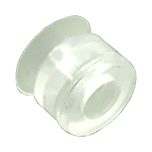
For number and placement: several smaller cups spread the load, stabilise against tilting and add redundancy should one cup leak. They are set as symmetrically as possible around the centre of gravity. On porous parts such as cardboard, wood or foam air escapes through the material, so higher suction flow, larger cups and a bigger safety factor are needed.
Frequently asked questions
How do I calculate a suction cup's holding force?
The theoretical holding force is the effective cup area times the vacuum reached. A cup with 20 cm2 of area gives about 120 N at 600 mbar. Divide that value by a safety factor of 2 to 4, depending on the motion and force direction.
When do I need a vacuum pump instead of an ejector?
An ejector generates vacuum compactly from compressed air and suits tight parts and short cycles. A vacuum pump delivers a high, continuous suction flow and is needed when many cups are supplied or when porous parts such as cardboard, wood or foam let air through.
Flat cup or bellows cup - which is better?
Flat cups hold flat, smooth parts with a low build height and high shear force. Bellows cups use the bellows to compensate height differences and angles and lift the workpiece gently, ideal for curved or delicate parts.
Size the right suction gripper
Holding force, ejector or pump, cup shape and material - we help with the sizing.
Reviewed
Content reviewed by pneumatics specialists.
Wide range
Flat and bellows cups in NBR and silicone in stock.
Ejector and pump
Vacuum generation for tight and porous parts.
Selection help
We help you choose the right products; technical details are clarified with the manufacturer.