
Solenoid valve 2/2 vs. 3/2 vs. 5/2 - which function for what?
A solenoid valve's designation states the number of ports first and the number of switching positions second. So 2/2 means two ports and two positions. From the ports, positions and the NC or NO function you can quickly tell which valve suits which task.
View solenoid valvesWhat do numbers like 2/2 or 5/2 mean?
The first number gives the number of ports (ways), the second the number of switching positions. So a 5/2 valve has five ports and two positions. This shorthand instantly shows how many lines are connected and how many states the valve can take.
For matching cylinder selection see the article ISO 15552 cylinders.
Which valve controls which task?
As a rule of thumb: 2/2 shuts off or releases a flow, 3/2 controls a single-acting cylinder, 5/2 a double-acting cylinder in both directions and 5/3 adds a mid position. The table below sums up ports, positions and typical uses.
| Type | Ports / positions | Typical use |
|---|---|---|
| 2/2 | 2 ports, 2 positions | shut off or release a flow, e.g. air or water |
| 3/2 | 3 ports, 2 positions | single-acting cylinder, NC or NO function |
| 5/2 | 5 ports, 2 positions | double-acting cylinder, reversing in two directions |
| 5/3 | 5 ports, 3 positions | double-acting cylinder with mid position, e.g. holding |
NC or NO, monostable or bistable?
NC (normally closed) is shut off when de-energised, NO (normally open) is open when de-energised. Monostable valves return to their initial position by spring, bistable valves hold the last position after a pulse, even once the signal is gone.
 NC vs. NO
NC is shut off de-energised, NO is open de-energised. The choice follows the safe rest state.
View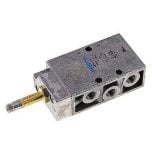 Direct vs. pilot-operated
Direct switches with the solenoid itself, pilot-operated uses a small pilot valve for more power.
ViewDirect-acting valves switch the flow directly with the solenoid force and suit small nominal sizes. Pilot-operated valves use the supply pressure via a pilot valve and thus switch larger cross sections with low solenoid power.
Frequently asked questions
What does the designation 5/2 mean on a solenoid valve?
The first number gives the number of ports, the second the number of switching positions. A 5/2 valve has five ports and two positions and typically controls a double-acting cylinder in both directions.
What is the difference between NC and NO?
NC (normally closed) is shut off when de-energised and only opens when energised. NO (normally open) is open when de-energised and shuts off when energised. The choice depends on the desired safe rest state.
When do I need a bistable instead of a monostable valve?
A monostable valve returns to its initial position by spring. A bistable valve holds the last position after a pulse, even without a continuous signal, and suits cases where the position must be kept on signal loss.
The right solenoid valve for your control task
2/2, 3/2, 5/2 or 5/3 - NC or NO, monostable or bistable. We help you select.
Reviewed
Content reviewed by pneumatics specialists.
Wide range
Valves from 2/2 to 5/3 in stock.
All functions
NC, NO, monostable and bistable available.
Selection help
We help you choose the right products; technical details are clarified with the manufacturer.