
How to Choose the Right Vacuum Switch for Handling
A vacuum switch monitors the negative pressure at a suction gripper and reports whether a part is held securely. This guide explains setpoint, hysteresis, output signal and accuracy, and shows how to select a switch or sensor for dependable part detection and process monitoring.
View vacuum switchesWhat does a vacuum switch do in handling?
A vacuum switch measures the negative pressure in the suction circuit of a gripper and sends a signal to the controller once a preset setpoint is reached. This lets the machine confirm that a workpiece is securely gripped before the next motion step begins. There are mechanical switches with a fixed threshold and electronic vacuum sensors with a display that also provide an analogue reading.
Vacuum is usually stated in kPa, mbar or as a percentage of absolute vacuum. A value of -70 kPa corresponds to roughly 70 % of the maximum attainable vacuum and is a common threshold above which a flat part is held reliably.
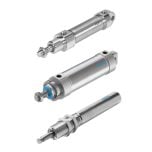 Suction cups and ejectors
How to size vacuum generators and grippers to match the workpiece.
View productsHow do you set the setpoint and hysteresis?
The setpoint is the vacuum level at which the output switches. Hysteresis is the gap between the switch-on and switch-back points and prevents the signal from chattering when pressure fluctuates around the threshold. Set both so that a held part is reported reliably and a lost part is detected without fail.
- Choose a setpoint above the level that securely holds a smooth, sealed part.
- For porous or uneven parts, set the setpoint lower and the hysteresis wider.
- Use two setpoints when part detection and leak warning must be reported separately.
- Mind the response time: a short reaction time suits fast cycle times in pick-and-place systems.
Which output and accuracy do you need?
The switching output must match the controller. PNP outputs switch the positive line and are the European standard, while NPN switches to ground. For continuous process monitoring, electronic sensors also provide an analogue signal of 1‑5 V or 4‑20 mA, and increasingly IO-Link for diagnostics and remote parameter setting.
Electronic sensors typically reach an accuracy of ±2 % of full scale, and premium devices achieve ±1 %. Repeatability and temperature drift matter too, because a setpoint close to the holding limit must not wander across the working temperature range.
- Choose an analogue output if you want to document leak trends or suction performance.
- IO-Link simplifies format changes because setpoints load centrally by recipe.
- Check the pressure port (M5, G1/8) and the protection rating from IP40 to IP67 for the environment.
- Display units make commissioning and troubleshooting easier right at the machine.
Frequently asked questions
In which unit is a vacuum switch set?
Common units are kPa, mbar or percent of end vacuum. -70 kPa is about -700 mbar and roughly 70 % of the maximum attainable vacuum. Many sensors let you switch the unit in the menu.
What is hysteresis for?
Hysteresis separates the switch-on and switch-back points and stops the output from toggling on small pressure fluctuations around the setpoint. A value of 5 to 10 % of the measuring range is a good starting point.
Do I need an analogue output or is a switch output enough?
A PNP or NPN switch output is enough for plain part detection. If you want to monitor leaks, declining suction or trends, an analogue output or IO-Link is the better choice.
Which setpoint suits a porous workpiece?
Porous or uneven parts never reach a high vacuum. Set the setpoint lower, around 30 to 40 % of end vacuum, and widen the hysteresis so the signal stays stable.
Looking for the right vacuum switch?
We supply mechanical vacuum switches and electronic vacuum sensors with PNP/NPN, analogue output and IO-Link - matched to part detection and process monitoring.
Calibrated
Sensors with documented accuracy down to ±1 % FS.
Matching outputs
PNP, NPN, analogue and IO-Link from stock.
Process-safe
Setpoint and hysteresis fully adjustable.
Selection help
We help you choose the right products; technical details are clarified with the manufacturer.