
What are ESD-compliant small parts storage systems and where are they used in industrial applications?
ESD-compliant small parts storage systems are specialized organizational solutions designed to safely store and protect electronic components from electrostatic discharge damage while maintaining efficient inventory management. These systems incorporate conductive or dissipative materials that comply with DIN EN 61340-5-3 standards to prevent static charge buildup during component handling and storage. Primary applications include electronics manufacturing, PCB assembly lines, semiconductor production facilities, and repair workshops where sensitive electronic components require protection from ESD events that can cause immediate failure or latent damage.
What are the key technical selection criteria for industrial small parts storage cabinets?
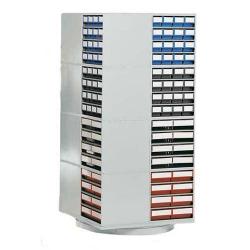
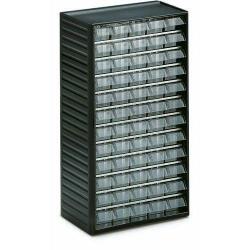
Selection of industrial small parts storage systems requires evaluation of cabinet dimensions, drawer capacity, and ESD compliance levels to match specific operational requirements. The Treston 4840 series offers high-density storage in 605x410x870mm footprint with multiple drawer configurations, while the 16-300 Spacemiser provides vertical storage efficiency in 700x700x1680mm dimensions for maximum floor space utilization. Critical selection factors include surface resistivity values meeting DIN EN 61340-5-3 requirements, load capacity per drawer typically ranging from 25-50kg, and modular expandability for future storage needs.
Which standards and certifications apply to ESD small parts storage systems?
ESD small parts storage systems must comply with DIN EN 61340-5-3 which specifies requirements for electrostatic discharge control in electronic component storage environments. This standard defines surface resistance limits between 10^6 and 10^12 ohms for dissipative materials and below 10^6 ohms for conductive materials used in storage cabinet construction. Additional applicable standards include IEC 61340-4-1 for test methods of electrostatic properties and workplace requirements, ensuring consistent ESD protection throughout the storage and handling process.
What are the main differences between ESD and standard versions of small parts storage cabinets?
The primary distinction between ESD and standard small parts storage cabinets lies in the material composition and surface treatment used in construction. ESD variants like the Treston 16-400 ESD incorporate conductive or dissipative materials with controlled surface resistivity values meeting DIN EN 61340-5-3 requirements, while standard versions use conventional steel or plastic without electrostatic discharge protection. ESD cabinets feature specialized coatings or material additives that prevent static charge accumulation, typically commanding a 15-25% price premium over standard equivalents but providing essential protection for sensitive electronic components.
What are the installation requirements and system compatibility considerations for modular storage systems?
Modular small parts storage systems require level flooring with minimum 150kg/m² load capacity to support fully loaded high-density cabinets and proper grounding connections for ESD-compliant installations. The Treston Spacemiser series requires 700x700mm floor space with additional 100mm clearance on access sides for drawer operation, while swivel stands need 360-degree rotation clearance. ESD systems must connect to facility ground through dedicated grounding points with resistance values below 1 megohm, and integration with existing conveyor systems or automated retrieval equipment requires compatible mounting interfaces and access heights.
What safety ratings and environmental operating conditions apply to industrial storage cabinets?
Industrial small parts storage cabinets typically operate within temperature ranges of -10°C to +40°C with relative humidity limits of 45-75% to maintain ESD material properties and prevent condensation formation. Standard versions achieve IP20 protection rating for basic dust ingress prevention, while specialized variants can reach IP54 for enhanced protection in demanding industrial environments. Load safety factors incorporate 3:1 minimum safety margins with drawer load capacities ranging from 25kg for light component storage to 100kg for heavy hardware applications, ensuring structural integrity under maximum loading conditions.
What maintenance schedules and inspection requirements apply to ESD storage systems?
ESD storage systems require quarterly surface resistance testing using calibrated electrometers to verify compliance with DIN EN 61340-5-3 resistance values between 10^6 and 10^12 ohms for dissipative surfaces. Annual mechanical inspection includes drawer slide lubrication, locking mechanism verification, and structural integrity assessment with expected service life exceeding 15 years under normal industrial usage. Grounding system continuity testing must occur semi-annually with resistance measurements below 1 megohm to ensure effective static charge dissipation, while surface cleaning with approved ESD-safe solvents maintains material properties and prevents contamination buildup.
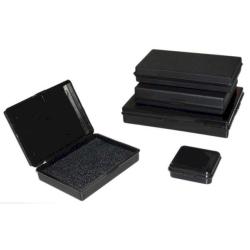
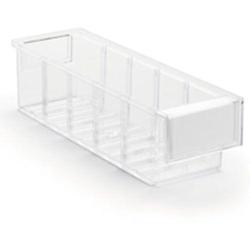
ESD-compliant small parts storage demands surface resistance values between 10⁵ and 10⁹ Ω across every bin, drawer, and cabinet surface - verified to IEC 61340-5-1. From stackable shelf bins with a volume as small as 0.1 l up to full-height visible storage cabinets accepting containers with footprints of 300 x 200 mm, the products in this category protect electrostatic-sensitive components (ESDs) during picking, kitting, and in-process buffer storage without additional discharge cycles.
As a specialist distributor for ESD workstation and storage solutions, esd.equipment stocks 307 products across small parts containers, storage bin cabinets, shelf bins, visible storage cabinets, and open-front storage bins - all meeting DIN EN 61340-5-1 and DIN EN 61340-5-2 norm requirements for protected EPA environments.
Typical application areas:
Electronics manufacturing and SMT assembly (IPC-A-610, IEC 61340-5-1), semiconductor back-end handling (SEMI S1/S2), medical device production (ISO 13485), automotive electronics assembly (IATF 16949, VDA 6.3), aerospace and defence electronics (AS9100), laboratory and R&D workstations requiring EPA-compliant component storage.
✓
Norm-compliant ESD storageAll products verified to IEC 61340-5-1 and DIN EN 61340-5-2 for EPA use
📦
307 products ready to shipContainers, bins, drawers and cabinets from leading ESD storage specialists
🛡
Full EPA system compatibilityGroundable surfaces, R < 10⁹ Ω, integrates with ESD workstation and flooring systems
This website uses cookies to improve your experience. By clicking “Accept”, you consent to the use of ALL the cookies. However you may visit Cookie Settings to provide a controlled consent.