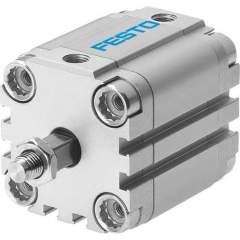
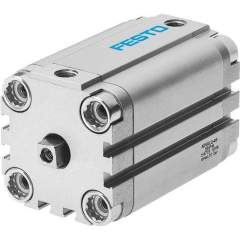
What are Festo ADVU and AEVU compact cylinders and which industries use them for pneumatic automation?
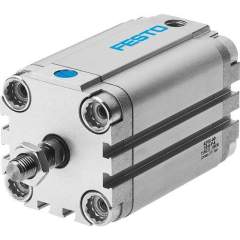
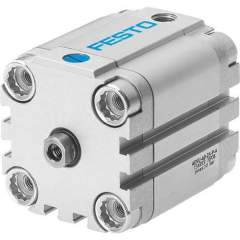
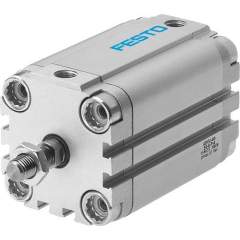
Festo ADVU and AEVU compact cylinders are double-acting pneumatic actuators designed for space-constrained industrial applications requiring precise linear motion control. These metric-dimensioned cylinders feature integrated piston rod guidance and compact housing designs, making them ideal for packaging machinery, automotive assembly lines, semiconductor manufacturing equipment, and general factory automation systems. The ADVU series offers standard stroke lengths from 10mm to 80mm with bore sizes including 100mm and 125mm variants, while AEVU models provide enhanced sealing for demanding environments. Manufacturing industries rely on these cylinders for pick-and-place operations, clamping mechanisms, and positioning tasks where consistent force delivery and compact installation footprint are critical requirements.
What are the key technical selection criteria for choosing between different Festo ADVU compact cylinder variants?
Selection of Festo ADVU compact cylinders depends primarily on bore diameter, stroke length, and mounting configuration requirements for the specific application. Available bore sizes include 100mm and 125mm diameters, with stroke lengths ranging from 10mm to 80mm as evidenced by models like ADVU-125-50-A-P-A and ADVU-100-80-P-A. Operating pressure typically ranges from 1.5 to 10 bar for standard compressed air applications, while force output scales directly with bore diameter and system pressure. The designation code indicates key specifications where the first number represents bore size, second number shows stroke length, and suffix letters define mounting style and port configurations. Critical selection factors include required thrust force, available installation space, mounting orientation, and connection thread specifications for pneumatic supply lines.
Which international standards and certifications apply to Festo ADVU and AEVU pneumatic compact cylinders?
Festo ADVU and AEVU compact cylinders comply with ISO 15552 standard for pneumatic fluid power cylinders, ensuring interchangeability and consistent mounting dimensions across manufacturers. These cylinders meet EN ISO 13849 safety requirements for pneumatic control systems and are designed according to ISO 8573 compressed air quality standards for optimal seal life and performance. The products carry CE marking indicating conformity with European machinery directives, while specific models may hold additional certifications like ATEX approval for explosive atmosphere applications. Manufacturing quality follows ISO 9001 standards, and environmental testing complies with EN 60068 for temperature cycling and vibration resistance. All sealing materials meet FDA requirements where food-grade applications are specified, ensuring broad applicability across regulated industries.
What are the main differences between Festo ADVU standard cylinders and ADVULQ variants shown in the product range?
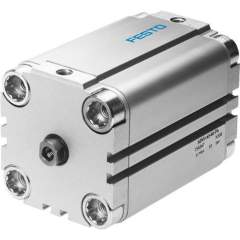
The primary difference between Festo ADVU standard compact cylinders and ADVULQ variants lies in the integrated linear guidance system and enhanced precision capabilities. ADVULQ models like the ADVULQ-100-60-A-P-A incorporate linear ball bearing guidance directly within the cylinder housing, eliminating the need for external guide rods and providing superior lateral load resistance up to 150N. Standard ADVU cylinders rely on piston rod guidance alone and are optimized for pure linear thrust applications with minimal side loading. ADVULQ variants offer improved positioning repeatability within ±0.1mm and reduced stick-slip behavior, making them suitable for precision assembly tasks and measurement applications. The integrated guidance system in ADVULQ models increases overall length but provides significant space savings compared to externally guided cylinder installations while maintaining identical bore sizes and pressure ratings.
What installation requirements and connection specifications apply to Festo ADVU metric compact cylinders?
Festo ADVU metric compact cylinders require ISO 5599-1 compatible valve mounting or direct piping connections using G1/8 or G1/4 pneumatic ports depending on bore size specifications. Installation mounting follows ISO 15552 standard dimensions, with foot mounting, flange mounting, or trunnion configurations available based on the suffix designation in model numbers like ADVU-125-50-A-P-A where 'A-P-A' indicates specific mounting and port arrangements. Minimum installation clearance requires 25mm around the cylinder body for maintenance access, while stroke length plus 50mm additional space must be available for full rod extension. Supply pressure connections accommodate standard compressed air systems from 1.5 to 10 bar, with integrated cushioning requiring no external flow control valves. Proper installation includes thread sealing compound on pneumatic connections and secure mounting bolt torque of 8-12 Nm for M6 fasteners to prevent vibration-induced loosening during operation.
What safety ratings and operating parameters define the environmental limits for Festo ADVU compact cylinders?
Festo ADVU compact cylinders operate safely within temperature ranges from -20°C to +80°C for standard sealing materials, with optional high-temperature seals extending operation to +150°C for specific applications. These cylinders maintain IP40 ingress protection rating as standard, providing adequate dust and moisture resistance for typical industrial environments, while IP65 variants are available for wash-down applications. Operating pressure limits span from 1.5 bar minimum for reliable actuation up to 10 bar maximum working pressure, with proof pressure tested to 15 bar during manufacturing. The cylinders handle compressed air quality according to ISO 8573-1 class 7:4:4, requiring basic filtration and lubrication for optimal seal life exceeding 10 million cycles. Safety factor of 4:1 applies to all structural components, while maximum lateral loading must not exceed 2% of axial force to prevent premature bearing wear and maintain specified service life.
What maintenance intervals and service life expectations apply to Festo ADVU pneumatic compact cylinders in industrial service?
Festo ADVU compact cylinders typically achieve 10 million operational cycles under normal industrial conditions with ISO 8573-1 class 7:4:4 compressed air quality and proper system pressure regulation. Preventive maintenance intervals include quarterly inspection of pneumatic connections for leakage, semi-annual compressed air quality verification, and annual seal replacement in high-duty applications exceeding 1 million cycles per year. Critical wear indicators include reduced stroke speed, pressure drop across cylinder ports exceeding 0.5 bar, and visible rod scoring or seal extrusion. Seal replacement intervals depend on operating frequency and air quality, ranging from 2-5 years for standard applications to annual replacement in contaminated environments or continuous-duty operations. Proper maintenance includes periodic lubrication using ISO VG 32 pneumatic oil, torque verification of mounting fasteners at 6-month intervals, and replacement of cushioning adjustment screws when thread wear prevents proper speed control during high-cycle applications.
Which compressed air quality requirements and system compatibility factors affect Festo ADVU cylinder performance and longevity?
Festo ADVU compact cylinders require compressed air meeting ISO 8573-1 quality class 7:4:4 specifications, corresponding to maximum particle size of 40 microns, pressure dew point of +3°C, and total oil content below 5mg/m³ for optimal seal life and consistent performance. System compatibility demands include supply pressure regulation within ±0.5 bar of set point, with recommended operating range between 4-8 bar for most industrial applications using standard 125mm and 100mm bore cylinders. Air preparation equipment must include 5-micron filtration, pressure regulation, and optional lubrication using ISO VG 32 pneumatic oil at 1-2 drops per cubic meter for enhanced seal protection. Contamination from moisture, particles, or chemical vapors significantly reduces service life from the standard 10 million cycles to as few as 2 million cycles in severe conditions. Proper system design includes downstream pressure relief valves set to 12 bar maximum and soft-start valves to prevent hydraulic shock during rapid pressure application to large bore cylinders exceeding 100mm diameter.