
Antistatic, dissipative or conductive - what is the difference?
Antistatic, dissipative and conductive are often mixed up, yet they name three different material classes. This guide sorts the terms by surface resistance per DIN EN 61340-5-1, shows where each belongs and clears up the most common misconceptions.
View ESD materialsWhat do antistatic, dissipative and conductive mean?
All three terms describe how quickly and how strongly a material drains electrical charge. The measure is electrical resistance in ohms (Ω): the lower the resistance, the faster the charge flows away. Conductive means very low resistance, dissipative a controlled middle range and antistatic really refers to a low tendency to charge up.
Conductive materials sit below 10⁵ Ω and drain charge almost instantly. Dissipative materials sit between 10⁵ and 10⁹ Ω and conduct charge slowly and in a controlled way, so a sensitive component is not hit by a sudden discharge current.
Which resistance ranges does the standard set?
DIN EN 61340‑5‑1 and the related test standards classify ESD material by surface or resistance to ground. The limits below are the common reference values you also find on data sheets.
For work surfaces and personnel grounding the standard typically calls for resistances in the dissipative to conductive range, so the charge drains in a controlled but reliable way. Pure packaging may be antistatic if it only protects the part from charging and does not itself serve as a ground path.
Which material belongs where?
The choice follows the function. People and work surfaces need a defined dissipation path, while packaging mainly needs low charging and, for sensitive parts, a shielding effect.
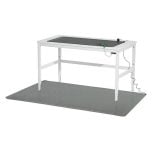
- Table mats and floor coverings: dissipative (10⁵-10⁹ Ω) so charge drains to ground in a controlled way.
- Wrist straps and personnel grounding: dissipative with a protective resistor, total path below 3.5 × 10⁷ Ω.
- Conductive bins and carts: conductive (< 10⁵ Ω) for fast equalisation of potential.
- Shielding bags: multilayer with a conductive layer, protects against field and discharge.
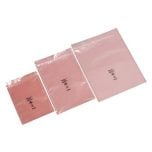
- Antistatic bags (pink poly): low charging only, NO shielding - not for bare components.
Which misconceptions are typical?
Stubborn myths surround ESD material. Knowing them helps you choose more reliably and avoid costly wrong purchases.
- "Antistatic equals ESD safe": no, antistatic only means low charging, not necessarily a dissipation path.
- "The lower the resistance the better": no, too low discharges too fast and can damage components.
- "Dissipative and conductive are the same": no, they differ by several orders of magnitude in resistance.
- "Tested once, valid forever": no, resistances change through abrasion, humidity and cleaning agents.
Frequently asked questions
What is the difference between dissipative and conductive?
Conductive materials sit below 10⁵ Ω and drain charge almost instantly. Dissipative materials sit between 10⁵ and 10⁹ Ω and drain charge more slowly and in a controlled way, which protects sensitive components from a sudden discharge current.
Is antistatic the same as ESD protected?
No. Antistatic only describes a low tendency to charge up when surfaces separate. An antistatic material can still be insulating and offers no full ESD protection without a defined dissipation path.
What resistance must an ESD work surface have?
Per DIN EN 61340‑5‑1 the resistance to ground of a work surface is typically in the 10⁵ to 10⁹ Ω range. This lets charge drain in a controlled yet reliable way.
Is a pink antistatic bag enough for circuit boards?
For plain storage without field exposure it may suffice because it limits charging. Sensitive populated assemblies, however, belong in metallised shielding bags that additionally protect against external fields and discharge.
Unsure which material class you need?
We supply antistatic, dissipative and conductive products - each with tested resistance values per DIN EN 61340-5-1.
Clearly defined
Every product with a stated resistance range.
Standard compliant
Values tested per DIN EN 61340-5-1.
Measurable
Resistance verifiable and documentable on site.
Selection help
We help you choose the right products; technical details are clarified with the manufacturer.