
24 V or 48 V DC - when is the switch worth it?
24 V is the workhorse of industrial control, but long runs and high currents make copper expensive. This guide compares 24 V and 48 V DC by line losses, wire gauge, component availability and the SELV safety limit at 60 V.
To the guidesContents
Why move from 24 V to 48 V at all?
For the same power, higher voltage means lower current. Doubling the supply from 24 V to 48 V halves the current for the same load. Because line losses grow with the square of the current, they drop to a quarter - and that is the real driver behind the switch.
The trend is pushed by power-hungry loads such as servo drives, automated guided vehicles (AGVs), robotics and decentralised drives. In these applications 24 V wiring becomes thick, costly and lossy, while 48 V carries the same power with half the copper.
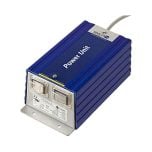
How much do line loss and wire gauge fall?
Voltage drop on a cable is U = I x R. Halving the current at 48 V halves the absolute voltage drop - and because the nominal voltage is twice as high, the percentage loss falls to a quarter. That buys you either longer runs or much smaller conductor cross-sections.
- Less copper: thinner conductors cut material and installation cost.
- Lower cable heating leaves more headroom in the cable tray.
- More stable voltage at the load, even at the end of long runs.
- More power through an existing cross-section when retrofitting.
What about components and availability?
This is where 24 V shines: sensors, valves, relays, PLC inputs and outputs and signalling devices are available almost everywhere in 24 V. 48 V parts are well established in drive technology, DC on-board grids and telecommunications, but rarer and often pricier in the classic control cabinet.
In practice a hybrid concept often wins: a 48 V rail for drives and power, plus a DC/DC converter down to 24 V for control, sensors and peripherals. You reap the loss advantage where power flows, without giving up the huge 24 V ecosystem.
- Keep 24 V for pure control and signal levels with many small loads.
- Choose 48 V for concentrated load, long runs or mobile drives.
- DC/DC converters couple both rails and keep the 24 V ecosystem available.
Which safety limits apply at 48 V?
The decisive advantage of both voltages: they stay below the SELV limit. As extra-low voltage (SELV/PELV) IEC 61140 and IEC 60364‑4‑41 define up to 60 V DC as the threshold for touch safety. 48 V sits safely below it and remains touch-safe - a key reason why 48 V is the preferred step up.
- SELV/PELV DC limit: 60 V (dry conditions), touch-safe.
- 48 V captures the loss advantage while staying well under the limit.
- Choose a power supply with safe isolation (SELV) and correct fusing.
- Check DC breaking capacity: direct current quenches arcs less easily than AC.
Frequently asked questions
Why does line loss fall to a quarter at 48 V instead of 24 V?
Double the voltage halves the current for the same power. Since loss grows with the square of the current (I² x R), halving the current drops it to a quarter.
Is 48 V DC still touch-safe?
Yes. The SELV limit is 60 V DC. At 48 V you stay clearly below it and within extra-low voltage, so no special shock-protection measures are needed.
Do I have to replace my 24 V sensors?
Not necessarily. A hybrid system is common: 48 V for drives and power, with a DC/DC converter continuing to feed the existing 24 V control and sensor level.
When is 48 V really worth it?
With high currents, long cable runs and concentrated loads such as servo drives or AGVs. For pure control with many small loads, 24 V usually stays the more economical choice.
24 V or 48 V - unsure how to size it?
Regulated power supplies and DC/DC converters for 24 V and 48 V systems need SELV safe isolation and correct fusing.
Both rails
24 V and 48 V power supplies plus DC/DC converters from one source.
SELV verified
Safe isolation below 60 V per IEC 61140.
Efficient design
Less copper, lower losses at high power.
Selection help
We help you choose the right products; technical details are clarified with the manufacturer.