
Choosing a Barcode Scanner: 1D or 2D, Wired or Wireless?
The right barcode scanner speeds up picking and goods receipt and cuts error rates noticeably. This guide explains the differences between 1D and 2D, wired and wireless, and laser and imager, and shows what matters for range, ruggedness and ingress protection.
To the guidesContents
1D or 2D: which code type fits?
A 1D scanner reads linear barcodes such as EAN-13, Code 128 or Code 39, which store information only across their width. A 2D scanner also captures matrix codes like QR Code, Data Matrix and PDF417, which hold data in both height and width and therefore fit far more characters.
2D codes still read even when partly damaged because they include built-in error correction. Data Matrix is common in goods receipt and electronics because it can be printed very small directly on components.
Laser or imager: how is it read?
Laser scanners sweep a barcode with a red line and read 1D codes only. Imagers work like a camera, capture an image and decode both 1D and 2D codes in any orientation.
The imager is less sensitive to minor damage and reads codes off a smartphone or monitor screen, which a laser cannot. The classic laser still scores at very long read distances and is often cheaper.
- Laser: reads 1D only, needs clean straight alignment, robust at long range.
- Imager: reads 1D and 2D, omnidirectional, reads from a display too.
- Imager copes better with scratched or poorly printed labels.
- For mixed supplier codes the imager is the safe choice.
Wired or wireless: which for which process?
Wired scanners connect via USB and are ready instantly without a battery, which makes them ideal for fixed checkout and packing stations. Wireless Bluetooth scanners give the operator freedom to move and reach up to 100 metres to the base station depending on class.
In goods receipt and with bulky pallets wireless shows its strengths because you bring the scanner to the goods rather than the other way round. Watch out for battery life, buffer memory for offline operation and the charging cradle.
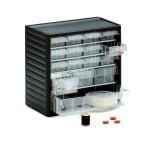 Warehouse organisation
How to structure shelves and small parts for fast order picking.
Read the guideHow rugged does the scanner need to be?
In tough warehouse use, ingress protection and drop resistance decide the service life. The IP rating per EN 60529 states how well a device is protected against dust and water, for example IP54 for splash water or IP65 for jet-water-protected units.
A further figure is the drop height a scanner survives onto concrete, typically 1.5 to 1.8 metres. For use in cold storage you should also check the permitted temperature range.
- IP54: protected against dust and splash water, for normal warehouses.
- IP65: dust-tight and jet-water-protected, for harsh environments.
- Drop height of 1.5 to 1.8 m onto concrete as a guide value.
- Check the temperature range, especially in chilled and frozen storage.
Frequently asked questions
Is a 1D scanner enough or do I need 2D?
If you only read classic retail barcodes, 1D is enough. As soon as QR or Data Matrix codes from suppliers or GS1 applications appear, a 2D imager is the safe choice because it reads 1D as well.
What is the difference between laser and imager?
A laser sweeps 1D codes with a line, while an imager captures an image and reads 1D and 2D in any orientation, including from a display. For mixed codes the imager is more flexible.
How far does a wireless scanner reach?
Bluetooth scanners typically reach 10 to 100 metres to the base station depending on class and environment. Walls and racking reduce range, while buffer memory bridges brief radio gaps.
Which IP rating do I need in the warehouse?
IP54 against dust and splash water is enough for normal warehouses. In dusty or wet environments IP65 makes sense. Also check for a drop resistance of 1.5 to 1.8 metres.
Looking for the right barcode scanner?
1D and 2D scanners, wired or wireless, with IP protection for picking and goods receipt - the guide covers selection and integration.
For every code
Devices for 1D and 2D codes in all common standards.
Rugged for the warehouse
IP ratings up to IP65 and high drop resistance.
Wired or wireless
USB and Bluetooth for every workstation.
Selection help
We help you choose the right products; technical details are clarified with the manufacturer.