
Buying a Bench Power Supply - What Really Matters?
A bench power supply delivers stable, adjustable DC voltage for development, repair and test benches. This guide covers the decisive buying criteria: channel count, programmable current limiting, display and setting resolution, and remote control over LAN, USB or GPIB.
To the guidesContents
How many channels does your bench need?
The channel count depends on the circuit you power. A single-channel unit is enough for simple tests, while mixed analog and digital circuits often need two or three separate voltages at once, for example +5 V, +3.3 V and a negative auxiliary rail.
Multi-channel supplies frequently offer a tracking feature. It couples two channels symmetrically to feed op-amps with ±15 V, or connects them in series to reach a higher total voltage from two rails.
Why does programmable current limiting matter?
A good bench supply runs in two modes: constant voltage (CV) and constant current (CC). When the current limit is reached, the unit switches automatically to CC mode and protects the device under test from overcurrent - essential when powering up a new board for the first time.
A finely adjustable current limit acts like an electronic fuse. You set the threshold just above the expected operating current, so a short circuit or an assembly error does not immediately destroy traces or components.
- CV/CC switching with a clear indication of the active mode.
- Independently adjustable overvoltage (OVP) and overcurrent (OCP) protection.
- Fast regulation response to keep current spikes in check.
- Output disable via a key without losing the setpoints.
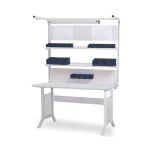 Set up an ESD test bench
Build a compliant, dissipative measurement station step by step.
View productsWhat resolution and accuracy make sense?
Resolution describes the smallest settable step, accuracy the deviation from the true value. For general electronics 10 mV and 10 mA are enough, while sensitive analog or sensor circuits benefit from 1 mV and 1 mA.
Consider setting resolution (how finely you enter the setpoint) and readback resolution (how finely the display reports voltage and current) separately. Low residual noise (ripple and noise, often below 1 mV rms) is decisive in audio and measurement work.
When is remote control and programmability worth it?
As soon as repeatable test sequences or documentation are needed, remote control shows its strengths. Over USB, LAN (LXI), RS-232 or GPIB the supply is driven and read out with SCPI commands from a test program.
Programmable units run voltage sequences automatically, log readings and integrate into test software such as LabVIEW or Python. On a production test bench this is the decisive difference between turning a knob by hand and reproducible, documented tests.
- USB and LAN (LXI) for easy PC connection and network operation.
- SCPI command set for vendor-independent scripts.
- Memory slots for frequently used setups at the front panel.
- Sequence or list mode for automatic voltage ramps.
- Sense lines (4-wire) to compensate cable losses.
Frequently asked questions
Linear or switching supply in the lab?
Linear bench supplies offer very low noise and fast regulation but are heavier and less efficient. Switching units deliver more power per volume with somewhat higher residual ripple. For sensitive measurement work, a linear or well-filtered output is preferable.
What does CV/CC mean on a bench supply?
CV stands for constant voltage, CC for constant current. In normal operation the unit holds the voltage. When the current reaches the set limit, it switches automatically to CC mode and limits the current to protect the device under test.
Do I need programmable remote control?
For occasional repairs manual operation is enough. As soon as test sequences must be repeatable and documented, a SCPI-capable unit with USB or LAN that integrates into test software pays off.
What is 4-wire (sense) measurement for?
Through two extra sense lines the supply measures the voltage right at the load and compensates the drop across the leads. This keeps the voltage at the device exactly at the setpoint, even at high current.
More on choosing the right bench power supply?
The guide explains what matters with single and multi-channel bench power supplies: programmable current limiting, fine resolution and remote control for development and test benches.
Tested safety
OVP and OCP reliably protect the device and the operator.
Precise resolution
Units down to 1 mV and 1 mA for sensitive circuits.
SCPI capable
Remote control over USB, LAN and GPIB for test routines.
Selection help
We help you choose the right products; technical details are clarified with the manufacturer.