
How to choose a flow meter - which principle fits?
The right flow meter depends mainly on the medium and the required accuracy. This guide compares the key measuring principles - variable area, electromagnetic and ultrasonic - and explains what matters for accuracy, measuring range and installation.
View flow metersContents
Which measuring principles are there?
Flow meters measure the quantity of a liquid or gaseous medium per unit of time. The three most common principles are the variable area meter (mechanical), the electromagnetic method (EMF) and ultrasonic measurement. Each has its own strengths regarding medium, accuracy and installation.
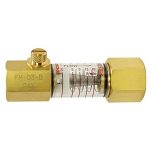
The variable area flow meter (rotameter) shows the flow directly via the height of a float in a tapered tube - robust, low-cost and without auxiliary power. Electromagnetic devices use Faraday's law of induction and measure only conductive liquids with no pressure loss. Ultrasonic meters determine the transit-time difference of two acoustic signals and work non-invasively, some even as clamp-on units from outside the pipe.
How do the principles differ in practice?
The key selection factors are medium, accuracy, pressure loss and price. The overview below summarises the typical properties.
- Variable area: no auxiliary power, direct reading, but position-dependent (vertical installation, flow from bottom to top).
- Electromagnetic: no pressure loss and no moving parts, but needs a minimum conductivity of about 5 µS/cm.
- Ultrasonic clamp-on: retrofittable without interrupting the process, ideal for existing pipework.
- Coriolis (additional option): also measures mass and density, but is considerably more expensive.
What matters for medium and measuring range?
The medium decides the principle, the measuring range decides the size. Key factors are viscosity, conductivity, temperature, solids content and the expected flow rate in l/min or m³/h.
- Check conductivity: below about 5 µS/cm (e.g. demineralised water, oils) the EMF technique is ruled out.
- Solids and bubbles: for heavily contaminated media avoid transit-time ultrasonic and consider the Doppler principle instead.
- Verify the temperature and pressure rating of seals and measuring tube - especially for heating and process water.
- Size the range so the operating point sits at 40‑70 % of full scale, not at the edge.
What to consider during installation?
Installation often affects accuracy more than the device itself. A disturbed flow profile behind bends or valves distorts the reading, so defined inlet and outlet runs per EN ISO 5167 apply.
- Observe the flow direction (arrow on the housing) during installation.
- Avoid vibration and strong magnetic fields near the EMF meter.
- After installation, perform a zero adjustment with the medium at rest.
- Document calibration and inspection intervals, especially for billing-relevant measurement.
Frequently asked questions
Which flow meter is the most accurate?
For conductive liquids, electromagnetic meters offer the highest accuracy at ±0.2 to 0.5 % of reading. Coriolis mass flow meters are even more precise but considerably more expensive.
Can I retrofit a flow meter without cutting the pipe?
Yes, ultrasonic clamp-on sensors are strapped onto the existing line from outside and measure non-invasively with no process interruption. This is well suited to retrofitting.
Why does an EMF meter not work with oil or pure water?
The electromagnetic principle needs an electrically conductive liquid (roughly from 5 µS/cm). Oils and demineralised water conduct too poorly, so ultrasonic or variable area meters fit better.
How long must the straight inlet run be?
As a guide, allow about 5x DN before an EMF meter and 10x DN before an ultrasonic meter, with 3x to 5x DN downstream. Exact values follow EN ISO 5167 and the disturbance source.
Looking for the right flow meter?
We supply flow meters using variable area, EMF and ultrasonic principles - matched to medium, measuring range and accuracy.
Calibrated
Devices available with traceable calibration certificate.
All principles
Variable area, EMF and ultrasonic from one source.
Standards-compliant
Installation documented per EN ISO 5167.
Selection help
We help you choose the right products; technical details are clarified with the manufacturer.