
Choosing a Heavy-Duty Workbench - What Matters?
A heavy-duty workbench carries motors, gearboxes and fixtures without flexing. This guide explains the right load capacity, the difference between bolted and welded frames and the correct worktop for machine building and heavy assembly.
View heavy-duty benchesContents
How much load capacity do you actually need?
Load capacity is the most important figure of a heavy-duty workbench. It states the evenly distributed weight the top can carry without permanent deformation. For machine building and heavy assembly, values of 500 to 1000 kg are common.
What counts is not only the static weight but also the point load. A 300 kg motor resting on four small feet stresses the top far more locally than a component lying flat. Always plan a reserve and choose a capacity that clearly exceeds the maximum real load.
- Light assembly and inspection: 300‑500 kg is enough.
- Machine building, gearboxes, hydraulics: 500‑750 kg recommended.
- Heavy assemblies, pressing, fixture work: 750‑1000 kg.
- Dynamic loads (hammering, joining) require extra reserve.
Welded or bolted frame?
The frame decides rigidity and service life. A welded steel frame from square tube is torsionally stiff and absorbs impacts without vibrating. Bolted systems are more flexible and easy to extend, but need regular checks of the connections.
Which worktop suits heavy assembly?
The top must match the task. Multiplex from laminated beech plywood is impact-resistant, protects workpieces and can be replaced. A steel or stainless overlay resists oil, heat and sparks and suits welding and grinding work.
- Multiplex 40‑50 mm: robust, quiet, good for assembly and fixture work.
- Steel sheet overlay: oil- and heat-resistant, ideal for maintenance.
- Stainless steel: corrosion-free, easy to clean, for test and clean areas.
- Plastic/HPL: chemical-resistant for lab and electronics assembly.
- An optional raised edge stops parts from rolling off.
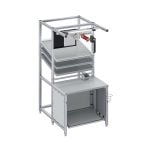
How much ergonomics does a heavy bench need?
Even a heavy-duty bench should suit the operator and the task. For standing work the recommended height is around 950 mm, and lower for precise seated fine assembly. Height-adjustable versions cover both cases.
Frequently asked questions
How much load capacity should a heavy-duty workbench have?
For machine building and heavy assembly, 500 to 1000 kg is common. Always plan at least a 30 percent reserve above the maximum real load, especially for point and alternating loads.
Is a welded frame better than a bolted one?
A welded frame is more torsionally stiff and low-maintenance, ideal for permanent heavy load. Bolted systems are easier to extend and transport but need regular checks of the joints.
Which top suits oil and heat?
A steel sheet or stainless overlay resists oil, sparks and heat, ideal for maintenance and welding. Multiplex is more impact-resistant and quieter for general assembly.
Can a heavy-duty bench be height-adjustable?
Yes, versions with crank or electric motor exist. Despite the high load rating they remain height-adjustable and suit changing operators and different tasks.
Looking for the right heavy-duty workbench?
We supply torsionally stiff heavy-duty benches with load capacity up to 1000 kg, welded steel frames and tops in multiplex, steel or stainless.
Rated capacity
Load capacity up to 1000 kg documented and tested.
Rugged frame
Welded steel frame, torsionally stiff and durable.
Matched worktop
Multiplex, steel or stainless to suit the job.
Selection help
We help you choose the right products; technical details are clarified with the manufacturer.