
Which workbench is right for my workstation?
A workbench is defined by four things: worktop load capacity, worktop material matched to the task, correct working height and a stable frame. This guide explains each of them and shows how to grow the bench into a complete workstation with accessories.
View workbenchesHow much load capacity and which worktop material do I need?
First choose the load capacity from the heaviest item on the top and the worktop material from the task. Light assembly is fine with 200‑500 kg, heavy fixtures need 750‑1000 kg. The material decides robustness, cleaning and ESD suitability.
Load ratings apply to an evenly distributed load. Point loads, overhanging fixtures or a vice at the edge reduce the usable reserve, so plan a deliberate buffer for these cases.
| Material | Property | Use |
|---|---|---|
| Multiplex / beech | robust, repairable, warm | workshop, mechanical assembly |
| ESD laminate | dissipative, grounded | electronics, EPA workstation |
| Stainless steel | chemical-resistant, hygienic | lab, food, wet areas |
| Linoleum | quiet, comfortable | inspection, packing, office assembly |
Which working height is ergonomically correct?
The right height depends on body size and task. As a guide, use 720‑760 mm for seated work and 950‑1100 mm for standing work. A height-adjustable frame covers both and lets several people share the bench across shifts.
- Fixed height: cheap and stiff, sensible for one person and a constant task.
- Levelling feet / notches: occasional tool-free adjustment, ideal for changing users.
- Crank or electric motor: smooth switch between sitting and standing during work.
- Stable frame: closed steel profile and cross braces stop sway during fine work.
- Steady stance: adjustable feet or lockable castors for a secure footing.
A torsionally stiff frame is the foundation: it carries the load and keeps the top steady while drilling, soldering or testing. Look for continuous welded or bolted joints and a cross member under the top.
How do I grow the bench into a complete workstation?
A modular bench scales with your needs: upright shelves, tool rails, lighting, a power channel and drawers can be retrofitted without replacing the bench. That keeps the worktop clear and tools within reach.
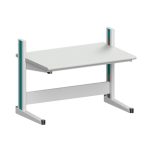 ESD workbench
Dissipative worktop and grounding for the compliant electronics workstation.
View products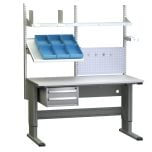
Frequently asked questions
How much load capacity should a workbench have?
Base it on the heaviest item plus a reserve. Light assembly is fine with 200‑500 kg, heavy fixtures and machines need 750‑1000 kg per top. Ratings assume a distributed load.
Fixed or height-adjustable - which is better?
Fixed height is stiffer and cheaper for one person with a constant task. Height-adjustable pays off with changing users, shift work or when switching between sitting and standing.
Which worktop material for electronics?
For ESD workstations, a dissipative, grounded ESD laminate top. It drains charges in a controlled way and protects sensitive components - see the ESD workbench guide.
Workbenches for every task
From the rugged workshop bench to the height-adjustable assembly station - with the right worktop material, load capacity and accessories from a single source.
High load capacity
Frames and tops for loads up to 1000 kg.
Reviewed
Content reviewed by workplace specialists.
Modular
Shelves, lights, rails and drawers to retrofit.
Selection help
We help you choose the right products; technical details are clarified with the manufacturer.