
IPC J-STD-001 - which soldering requirements really apply?
IPC J-STD-001 is the world's leading standard for soldered electronic assemblies. This guide explains the three product classes, the concrete process requirements, operator qualification through CIS and CIT, and the documentation you must keep.
View solderingContents
Which product classes does IPC J-STD-001 define?
IPC J-STD-001 divides electronic assemblies into three reliability classes. The class determines how strict the process, inspection and acceptance criteria are, and it is set by the customer or the application.
Class 1 covers general electronics where basic function is what matters. Class 2 covers assemblies with increased reliability and long service life, such as industrial and communication equipment. Class 3 applies to high reliability where failure is not tolerated, for example in aerospace, medical and military applications.
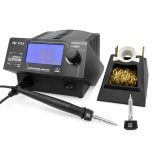 Soldering iron and station
How to choose the right soldering station for standard-compliant work.
Read the guideWhat does the standard require for the soldering process?
IPC J-STD-001 requires a controlled and repeatable process. Central topics are material selection, temperature control, cleaning and the avoidance of defects such as cold joints or insufficient wetting.
- Solders and fluxes must be defined and released for the application (lead-free or leaded).
- Iron tip temperature and dwell time must be controlled, often between 315 and 370 °C with short contact times.
- Moisture-sensitive devices (MSD) must be stored and pre-baked according to J-STD-033.
- A dissipative ESD workstation is required per the electrostatic discharge section of J-STD-001.
- Cleaning or a controlled no-clean process with documented residue verification.
Temperature control is decisive: a regulated station typically holds the tip temperature stable within about ±5 °C and prevents thermal damage to the component and the board. Lead-free solders melt at higher temperatures, which places greater demands on the station and the tip.
How are operators and trainers qualified?
IPC J-STD-001 is taught through a two-tier training system. The Certified IPC Trainer (CIT) is authorised to train, while the Certified IPC Specialist (CIS) is the trained operator on the production line.
Certification runs through IPC-licensed training centres. A CIT completes training on the master standard and may then train CIS operators within their own company. Certificates are typically valid for two years and must be renewed afterwards.
What documentation does IPC J-STD-001 demand?
Without documentation, conformity cannot be proven. The standard requires that process parameters, materials, qualifications and inspection results are recorded in a traceable way.
- Released manufacturing documents with a defined product class.
- Evidence of the solders and fluxes used, including their batches.
- Records of process controls such as temperature and cleaning results.
- Valid CIS and CIT certificates for the personnel.
- Inspection and acceptance records including rework and repair.
Frequently asked questions
What is the difference between IPC J-STD-001 and IPC-A-610?
J-STD-001 is a process standard that prescribes how soldering is done, including materials and qualification. IPC-A-610 is a pure acceptance standard that judges the finished result. The two are often used together.
Which class do I need for my assembly?
It depends on the application. Consumer electronics usually falls under Class 2, while safety-critical products such as medical or aerospace equipment require Class 3. The customer defines the class in the contract.
How long is an IPC certification valid?
CIS and CIT certificates are generally valid for two years. After that a recertification is required so that personnel stay current with the latest revision of the standard.
Does J-STD-001 also cover lead-free soldering?
Yes, the standard covers both leaded and lead-free processes. With lead-free solders the higher melting temperatures and the demands on the station and tip deserve particular attention.
Soldering to IPC J-STD-001?
We supply regulated soldering stations, dissipative workstations and accessories for a controlled, documentable soldering process.
Process-safe
Equipment for controlled soldering processes to IPC J-STD-001.
Temperature-regulated
Stations with stable tip temperature for Class 2 and 3.
Selection help
We help you choose the right products; technical details are clarified with the manufacturer.
Documentable
Equipment that enables traceable process control.