
Rack inspection under DGUV: who checks racks and how often?
Anyone operating storage racking must have it checked for safety on a regular basis. This guide explains the annual inspection duty under DGUV Rule 108-007 and DIN EN 15635, the traffic-light damage classes, the role of the rack inspector and how to document it correctly.
View storage systemsContents
Why is rack inspection mandatory?
Storage racks are work equipment and fall under industrial safety regulation. DGUV Rule 108‑007 and DIN EN 15635 therefore require the operator to maintain racking and have it checked for a safe condition on a regular basis.
Responsibility always sits with the operator, meaning the company. It appoints a competent person (PRSES) as the rack inspector and ensures that damage is documented and repaired before it becomes a hazard.
- The operator is responsible for the safe condition.
- A safety officer watches the racks in daily operation.
- A rack inspector carries out the annual expert check.
- The basis is DGUV 108‑007 and DIN EN 15635.
How often must racks be checked?
The standard defines two levels: the ongoing visual check in daily use and the documented expert inspection at least once a year. The two complement each other and differ in how demanding they are.
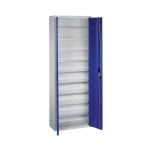 Storage & Small Parts
Build up racking, shelves and small-parts storage to match your needs.
View productsWhat do the damage classes mean?
DIN EN 15635 rates damage with a traffic-light system. The decisive figure is the residual deformation of a component, measured over a reference length of 1 metre.
- Upright limit: about 3 mm deformation over 1 m length.
- Beam limit: about 5 mm deflection.
- Red means immediate unloading, isolation and replacement.
- Damaged parts are replaced, not straightened.
How is the inspection documented?
Every expert inspection must be recorded in writing. The rack inspector produces a report with the date, the racks checked, the damage found by traffic-light class and the actions required.
- Inspection date and name of the inspector.
- Clear identification of each rack run.
- Damage class and a photo for each finding.
- Deadline and person responsible for the repair.
- Confirmation that the repair has been carried out.
Frequently asked questions
Who may carry out a rack inspection?
The annual expert inspection is done by a competent person as defined in the risk assessment, often a certified rack inspector. The weekly visual check is handled by a trained employee.
How often must a rack be inspected?
At least once a year by a competent person, supported by a regular, usually weekly, visual check. Heavy use may require shorter intervals set by the risk assessment.
What does a red-rated damage mean?
Red means the deformation exceeds twice the limit value. The rack bay must be unloaded immediately, cordoned off and the component replaced.
May a bent upright be repaired?
No. Load-bearing parts are not straightened or welded but replaced with original components. Only this keeps the rated load capacity intact.
Racking and accessories for a safe warehouse?
We supply pallet racking, shelving and spare parts as well as rack protection and labelling - ready for a standard-compliant rack inspection.
Standard-compliant
Equipment matched to DGUV 108-007 and DIN EN 15635.
Documentable
Load signs and labelling for your records.
Spare parts
Uprights and beams for quick replacement.
Selection help
We help you choose the right products; technical details are clarified with the manufacturer.