
How does reflow soldering work?
In reflow soldering, solder paste is first applied through a stencil onto the board, then the components are placed and the whole assembly is heated in a reflow oven. The paste melts and forms all joints at once. The temperature profile controls preheat, soak, reflow and cooling.
To soldering guideWhat is reflow soldering and how does it work?
Reflow soldering is a process in which solder paste is printed through a stencil onto the pads of the board. The components are then placed and the complete assembly passes through a reflow oven. The heat melts the paste, so all joints form together in a single pass.
Solder paste is a mix of fine solder powder and flux. During placement the sticky paste holds the SMD components in position. In the oven the flux activates the surfaces, the solder powder melts and wets pad and component lead, and on solidifying it forms the solid solder joint.
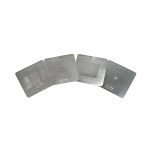 Apply solder paste via stencil
The stencil sets the amount and position of the solder paste and thus the quality of the joints.
View productsWhat does the temperature profile look like?
The temperature profile divides the oven pass into four zones: preheat, soak or activation, reflow with the peak above the alloy melting point, and cooling. For SAC305 the melting point is around 217 °C and the peak temperature is typically 240‑250 °C.
During preheat the assembly is warmed evenly to avoid thermal shock. In the soak phase the temperatures equalise and the flux activates. In the reflow zone the solder exceeds its melting point and wets the leads. During cooling the joint solidifies in a controlled way.
| Zone | Purpose | Temperature (rough) |
|---|---|---|
| Preheat | Warm evenly, avoid thermal shock | Room temp. to approx. 150 °C |
| Soak / activation | Equalise temperatures, activate flux | 150-180 °C |
| Reflow (peak) | Solder melts, wets all joints | 240-250 °C peak |
| Cooling | Solder solidifies, solid joint forms | below 217 °C |
 Lead-free alloys and temperature
SAC305 melts higher than leaded solder, which sets the peak and time window in the profile.
Read lead-free solderingReflow or hand and hot-air soldering?
Reflow soldering pays off for SMD assembly in series, because all joints of a board form in a single pass. Hand and hot-air soldering remain the choice for single pieces, repair, rework and through-hole components, where an oven process is not practical.
- Reflow: high throughput and repeatable quality for series with many SMD components.
- Hand soldering: flexible for single pieces, prototypes and through-hole leaded parts.
- Hot air: good for repair, rework and desoldering individual SMD components.
- All methods use the same alloy, such as SAC305, but different ways of applying heat.
Frequently asked questions
What is the peak temperature in reflow soldering?
For the lead-free alloy SAC305 with a melting point of around 217 °C, the peak temperature is typically 240‑250 °C. The exact value depends on the solder paste used, whose datasheet specifies the peak temperature and the time above the melting point.
Which zones does a reflow temperature profile have?
A profile has four zones: preheat for even warming, soak or activation to equalise temperature and activate the flux, reflow with the peak above the melting point, and cooling for controlled solidification of the joints.
When is reflow worth it over hand soldering?
Reflow pays off for SMD assembly in series, since all joints of a board form at once. For single pieces, prototypes, repair, rework and through-hole components, hand and hot-air soldering remain the right choice.
Reflow soldering equipment overview
From the solder paste through the stencil to the right profile, we help you select the soldering technology.
Selection help
We help you choose the right products; technical details are clarified with the manufacturer.
Vendor-neutral
Standards and facts instead of product marketing.
Practical
Profile zones and process clearly explained.
Selection help
We help you choose the right products; technical details are clarified with the manufacturer.