
How do you solder lead-free correctly?
Lead-free soldering with SAC305 (SnAgCu) needs a work temperature of 350-380 °C because the alloy melts around 217 °C, plus good thermal recovery and careful tip care. The RoHS directive 2011/65/EU bans lead in electronics.
To soldering guideWhy solder lead-free at all?
The EU RoHS directive 2011/65/EU bans lead in electrical and electronic equipment above a limit of 0.1 percent by weight. Lead-free soldering is therefore mandatory for electronics placed on the market, unless a specific exemption applies.
Lead is toxic and accumulates in the environment and the body. RoHS reduces lead entering the waste stream through electronic scrap and harmonises requirements across the EU single market. Repair and rework on existing devices must consider the alloy used to keep joints reliable.
Which alloy and which temperature do I need?
SAC305 (96.5 % Sn, 3.0 % Ag, 0.5 % Cu) is the most widely used lead-free alloy. It melts around 217 °C, clearly higher than the eutectic tin-lead alloy Sn63Pb37 at 183 °C. This leads to a typical work temperature of 350‑380 °C versus about 330 °C for leaded solder.
The higher temperature means more thermal stress for components and the tip. A soldering station with good thermal recovery keeps the tip temperature stable when it touches the joint instead of collapsing. That keeps the heat input short and controlled.
| Property | Leaded (Sn63Pb37) | Lead-free (SAC305) |
|---|---|---|
| Melting point | 183 °C | 217 °C |
| Work temperature | approx. 330 °C | 350-380 °C |
| Wetting | very good | slower, duller |
| Tip wear | low | higher |
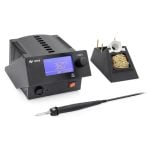 Choose the right station
Thermal recovery and power reserve decide the quality of lead-free soldering.
View productsNo-clean or water-soluble - which flux?
Because lead-free alloys wet more slowly, the flux is decisive. Common options are no-clean fluxes, whose residues may remain on the assembly, and water-soluble fluxes, which wet more actively but must be washed off completely.
- No-clean: low residue, no washing step needed, suitable for most hand soldering.
- Water-soluble: very active with good wetting, but requires thorough cleaning as residues can be corrosive.
- A flux core in the wire or added flux noticeably improves wetting with lead-free solder.
How do I protect the tip from fast wear?
The higher temperature and higher tin content of lead-free solder make tips wear faster. The iron plating is attacked more strongly. Consistent tip care extends service life significantly and keeps heat transfer stable.
- Always store the tip tinned and re-tin before breaks.
- Set the temperature only as high as needed, do not work permanently at the upper limit.
- Dry cleaning with brass wool is gentler on the plating than a wet sponge.
- For oxidation use an activator or tip refresher instead of scraping mechanically.
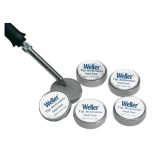 Care for tips correctly
Tinning, cleaning and temperature control keep heat transfer intact with lead-free solder.
View productsFrequently asked questions
At what temperature do you solder lead-free?
SAC305 melts around 217 °C, so the work temperature is typically 350‑380 °C. That is higher than leaded solder at about 330 °C. Avoid working permanently at the upper limit to protect components and the tip.
Why do lead-free joints look duller?
Lead-free alloys such as SAC305 wet more slowly and solidify with a duller, slightly grainy surface. A dull joint is normal with lead-free solder and not a quality defect, as long as it is well formed and fully wetted.
Do soldering tips wear faster with lead-free?
Yes. Higher temperature and higher tin content attack the iron plating more strongly. With consistent tinning, moderate temperature and gentle cleaning you can extend service life considerably.
Lead-free soldering equipment
From the alloy through flux to the right station, we help you select RoHS-compliant soldering equipment.
RoHS-compliant
Lead-free alloys per directive 2011/65/EU.
Selection help
We help you choose the right products; technical details are clarified with the manufacturer.
Vendor-neutral
Standards and facts instead of product marketing.
Selection help
We help you choose the right products; technical details are clarified with the manufacturer.