
Solderability Testing - Wetting Balance or Dip Test?
Solderability testing shows whether a component lead or a PCB will wet reliably with solder. This guide explains the two standard methods - the wetting balance and the dip-and-look test - to IPC/J-STD-002 and J-STD-003, the key metrics and how to interpret the result.
View test equipmentWhy test solderability at all?
Solderability is the ability of a surface to be wetted by molten solder and form a sound metallurgical joint. Component leads and PCB pads age through storage, oxidation and humidity, so their once good wettability degrades over time. Testing to IPC/J-STD reveals poor batches before they reach series production.
Poor solderability causes non-wetting, dewetting and cold spots that only show up as field failures much later. Incoming inspection and quality assurance therefore use the test as a release criterion for tin, silver or ENIG finishes.
- Incoming inspection of aged or long-stored components.
- Qualification of new suppliers and surface finishes.
- Root-cause analysis of sporadic soldering defects in production.
- Proof of remaining shelf life before the expiry date.
Wetting balance or dip-and-look test?
There are two established methods. The dip-and-look test is fast and visual, while the wetting balance (meniscograph) yields an objective force-time curve. The choice depends on the level of confidence required and the part geometry.
In the dip-and-look test the lead is fluxed, dipped into molten solder under defined conditions and then judged under a loupe or microscope. The wetting balance immerses the sample on a precision balance and records wetting force over time, producing a repeatable curve with wetting time and peak force.
How does the IPC/J-STD test run?
Both methods follow a fixed sequence: condition, flux, dip into a controlled solder bath and evaluate. The standard fixes solder temperature, immersion depth, speed and dwell so that results stay comparable across labs.
- Conditioning: optional artificial ageing (steam, heat) to simulate storage.
- Flux: a standardised test flux, usually mildly activated (ROL0/ROL1).
- Solder bath: lead-free SAC305 at around 245 °C, tin-lead SnPb at around 235 °C.
- Immersion: defined depth, speed about 20‑25 mm/s, dwell 2‑5 s.
- Evaluation: wetting time t₂/₃, peak wetting force Fmax and wetted area.
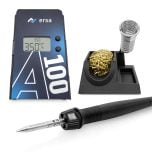 Choose a soldering station
The right temperature and tip for good wetting in hand soldering.
View productsFrequently asked questions
What is the difference between J-STD-002 and J-STD-003?
J-STD-002 tests the solderability of component leads and wires, J-STD-003 tests printed boards and their pads. Their test media and acceptance criteria are matched to each object.
How long may the wetting time be?
A wetting time t₂/₃ below 1 to 2 seconds is considered good. Values well above that point to oxidised or poorly wettable surfaces.
Do components need artificial ageing before testing?
To assess remaining shelf life, yes. The standard prescribes a steam or heat conditioning that simulates a typical storage period and makes the result more realistic.
Is a simple dip-and-look test enough?
For incoming inspection it often is. For disputed results or safety-critical assemblies the wetting balance provides objective measurements and is preferable.
Need to test solderability reliably?
We supply test fluxes, solder baths and accessories for solderability testing to IPC/J-STD-002 and J-STD-003 - from incoming goods to the lab.
Standard-compliant
Methods per IPC/J-STD-002 and J-STD-003.
Measurably judged
Wetting time and area are documentable.
Lead-free and leaded
Solder baths for SAC305 and SnPb available.
Selection help
We help you choose the right products; technical details are clarified with the manufacturer.