
Choosing the OIML test weight class: E2, F1, F2 or M1?
OIML R111 defines the accuracy classes E2, F1, F2 and M1 - from most to least accurate. The test weight must be tighter in tolerance than the balance it checks. Rule of thumb: weight tolerance should be at most one third of the readability. Always handle with gloves or tweezers.
View test weightsWhich classes does OIML R111 define?
OIML R111 is the international standard for test weights. It defines the accuracy classes E2, F1, F2 and M1 - from the tightest to the widest tolerance. The higher the class, the smaller the permitted deviation of the weight from its nominal value.
| Class | Typical use | Relative accuracy |
|---|---|---|
| E2 | Analytical balances, reference weights | very high |
| F1 | Precision balances, laboratory | high |
| F2 | Precision and fine balances | medium |
| M1 | Industrial and trade scales | lower |
How do I match the class to the balance?
The test weight must be tighter in tolerance than the balance it checks. Proven rule of thumb: the weight tolerance should be at most one third of the balance readability or measurement uncertainty. That keeps the weight itself a negligible source of error.
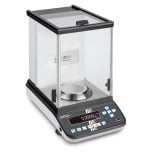
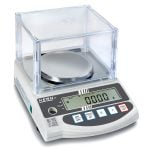
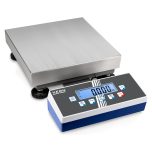
Related: choosing a scale and calibrating a scale.
How do I handle test weights correctly?
High-accuracy weights are sensitive to contamination and finger grease. Never touch class E2 and F1 weights with bare hands - grip them only with gloves, tweezers or a fork. Skin grease and moisture change the mass measurably.
Test weights are themselves subject to control and should be recalibrated regularly. The timing and interval depend on the class and the usage.
Frequently asked questions
Which test weight class do I need for my balance?
The weight should be tighter in tolerance than the balance. Rule of thumb: tolerance at most one third of the readability. E2 for analytical balances, F1 or F2 for precision balances, M1 for industrial scales.
What does the order E2, F1, F2, M1 mean?
It describes accuracy from high to low. E2 has the tightest tolerance, M1 the widest. Higher classes cost more and are more sensitive to handle.
May I touch test weights by hand?
Not class E2 and F1 weights with bare hands. Skin grease and moisture change the mass. Always use gloves, tweezers or a fork and store them dry.
The right test weight per OIML R111
E2, F1, F2 and M1 - calibratable, with certificate and matching accessories from a single source.
Per OIML R111
Classes E2 to M1 standard-compliant.
Reviewed
Content reviewed by measurement specialists.
Accessories included
Gloves, tweezers and boxes in stock.
Selection help
We help you choose the right products; technical details are clarified with the manufacturer.