
Choosing a balance by accuracy: analytical, precision or industrial?
The right balance depends above all on readability d, the smallest displayed step. Analytical balances resolve to 0.1 mg, precision balances sit between, industrial balances are coarser and rugged. There is always a trade-off between weighing range and readability.
View balancesContents
Why is readability d the most important spec?
Readability d is the smallest step the balance displays - for example 0.1 mg, 1 mg, 0.1 g or 1 g. It sets how finely you can weigh and matters more than the maximum capacity alone. The finer d is, the more sensitive the balance is to draught, vibration and temperature.
Analytical, precision or industrial - which class?
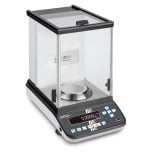
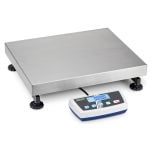
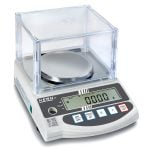
Three classes cover the field: the analytical balance for the lab at 0.1 mg (0.0001 g), the precision balance from 1 mg to 0.1 g, and the rugged industrial or platform scale from 1 g. Choose the finest resolution your task genuinely needs.
| Balance type | Typical readability d | Use |
|---|---|---|
| Analytical balance | 0.1 mg (0.0001 g) | Lab, sample weighing, formulation |
| Precision balance | 1 mg to 0.1 g | Workshop, QC, counting |
| Industrial / platform scale | 1 g and coarser | Production, shipping, pallets |
How do weighing range and readability relate?
There is a trade-off between maximum capacity (Max) and readability d: a very fine resolution usually comes with a smaller weighing range. Analytical balances often weigh only up to around 200 g, while industrial scales handle many kilograms - but far more coarsely.
Check the balance regularly with matching test weights - see Test weights to OIML and Scale calibration.
When is verification (legal-for-trade) required?
Verification is legally required whenever the balance is the basis for price or quantity in commerce - such as selling by weight or official measurements. Such balances must be compliant and carry a verified class (OIML R76).
Frequently asked questions
What does readability d mean on a balance?
Readability d is the smallest step the display shows, for example 0.1 mg or 1 g. It sets how finely you can weigh, but it is not the same as the measurement uncertainty.
Which balance do I need for the lab?
For sample weighing and formulation in the lab an analytical balance at 0.1 mg is usually right. For coarser lab work a precision balance from 1 mg to 0.1 g is often enough.
Does my scale have to be verified?
Verification is required when the scale determines price or quantity in commerce. For internal control and quality assurance a calibration is normally sufficient.
The right balance for your accuracy
Analytical, precision and industrial balances - plus test weights to OIML from a single source.
All classes
From the analytical balance to the platform scale.
Reviewed
Content reviewed by measurement specialists.
Accessories
Test weights and calibration service available.
Selection help
We help you choose the right products; technical details are clarified with the manufacturer.