
Choosing a force gauge and test stand: what matters?
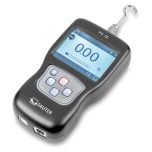
A digital force gauge measures tension and compression forces in newtons. What matters is the right measuring range, the accuracy and the choice of test stand. A manual stand suits spot checks, while a motorised test stand at constant speed gives repeatable values for series and QA.
View force gaugesHow does a force gauge measure and what is the measuring range?
A digital force gauge senses the applied force through a load cell and shows it in newtons (N). Pick the measuring range so the expected working force sits at roughly 20 to 90 percent of full scale - that keeps the reading accurate and avoids overload.
Once the range fits, the same logic applies to picking a scale - see Choosing a scale.
Tension or compression - which test do I need?
In a tension test the force pulls on a joint - for example pull-off, pull-out or holding forces. In a compression test the force presses or crushes - for example actuation, break or spring forces. Most gauges measure both directions; fittings such as hooks, plates or clamps transfer the force cleanly.
Manual or motorised test stand?
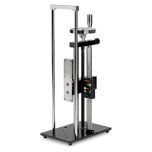
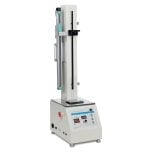
A manual test stand (screw or lever drive) guides the force gauge straight and suits spot checks. A motorised test stand travels at constant speed and delivers repeatable values - the basis for series testing and QA.
| Feature | Manual test stand | Motorised test stand |
|---|---|---|
| Drive | screw or lever, by hand | motor with adjustable speed |
| Speed | depends on the operator | constant and repeatable |
| Repeatability | limited | high |
| Typical use | spot checks, setup | series, QA, documentation |
| Effort | low, mobile | higher, stationary |
Frequently asked questions
How do I pick the right measuring range?
So the expected working force sits at roughly 20 to 90 percent of full scale. Too large a range wastes accuracy, too small risks overload.
What does accuracy of full scale mean?
The deviation refers to the full scale value of the range, typically around 0.5 percent. Near the bottom of the scale the relative error grows, so choose a fitting range.
When is a motorised test stand worth it?
As soon as values must be repeatable and documented - for series testing and QA. For occasional spot checks a manual test stand is enough.
The right force gauge and test stand
Digital force gauges for tension and compression plus manual and motorised test stands - from a single source.
Reviewed
Content reviewed by measurement specialists.
Tension and compression
Gauges for both test directions.
Complete
Force gauge and test stand from a single source.
Selection help
We help you choose the right products; technical details are clarified with the manufacturer.