
Choosing a Wire Stripper: Automatic or Manual?
The right wire stripper removes insulation cleanly without nicking the fine strands. This guide compares automatic and manual strippers, explains the cross-section range in mm² and shows how to strip wire without conductor damage.
View wire strippersAutomatic or manual - which suits your work?
There are two main designs: self-adjusting automatic strippers and manual strippers with fixed notches. The automatic tool grips, cuts and pulls off the insulation in a single squeeze and adjusts itself to the conductor size. The manual tool requires you to pick the matching notch and pull the insulation off by hand.
For high volumes and changing cross-sections the automatic stripper is faster and easier on the hand. The manual stripper wins with very fine strands, tight spaces and when you want exact control over the strip length.
Which cross-section range is right?
The cross-section range states which conductor sizes in mm² the tool handles. Typical universal strippers cover about 0.2 to 6 mm², fine electronics models reach down to 0.08 mm², while strippers for installation cables go up to 10 mm² and beyond.
- Electronics and fine strands: 0.08‑1 mm², often in tenth steps.
- Universal and control wiring: 0.2‑6 mm², the most common everyday range.
- Installation and power: 1.5‑10 mm² and above.
- Note the AWG value if your data sheets use American Wire Gauge.
- Check that both solid and flexible conductors are covered.
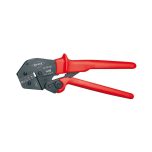 Crimping pliers
Stripping is often followed by crimping ferrules - how to pick the matching tool.
View productsHow do you strip without damaging the strands?
A nicked or severed strand reduces the usable cross-section, raises the contact resistance and can lead to breakage. What matters is the correct blade or notch size, a clean length stop and the condition of the cutting edges.
On the automatic stripper you set the strip length with the length stop and check that the clamping jaws grip the conductor centrally. On the manual stripper the chosen notch must match the cross-section exactly, otherwise it cuts into the copper.
- Select the matching notch or automatic setting for the cross-section.
- Keep the blades clean and sharp, replace worn strippers.
- After stripping, check the strand count - missing wires signal the wrong setting.
- Do not twist fine-stranded conductors before they enter a contact or ferrule.
Frequently asked questions
Automatic or manual wire stripper - which is better?
For many changing cross-sections and high volumes, the self-adjusting automatic is faster and gentler. For very fine strands and tight spots the manual stripper gives more control.
What does the cross-section range in mm² mean?
It states which conductor sizes the tool strips cleanly, for example 0.2 to 6 mm². Your standard cross-section should sit near the middle of that range.
How do I avoid damaged strands?
Select the matching notch or automatic setting, keep the blades sharp and count the strands after stripping. Missing wires mean the setting was too small.
Does one stripper handle solid and flexible conductors?
Many do, but not all. Check the data sheet to confirm that both solid and fine-stranded conductors are covered in the stated range.
Looking for the right wire stripper?
We supply automatic and manual wire strippers for every cross-section range - for clean stripping without strand damage.
Clean cut
Precise blades for stripping without strand damage.
Every cross-section
Models from 0.08 to over 10 mm².
Both designs
Automatic and manual strippers in stock.
Selection help
We help you choose the right products; technical details are clarified with the manufacturer.