
Round-nose pliers - when do you really need them?
Round-nose pliers bend wire into clean loops, rings and curves at a defined radius. This guide explains when they are the right tool, which jaw diameters match which wire size, and what to look for in material, jaw shape and grip.
View round-nose pliersWhen do you need round-nose pliers?
You need round-nose pliers whenever wire has to be bent in a controlled way rather than cut or gripped flat. Both jaws taper to a round tip, so the wire wraps around a defined radius - ideal for loops, coils and tight curves.
Typical jobs are forming wire loops on component terminals, pre-bending leads before soldering, fine bending work in model making, plus jewellery and repair tasks. For straight gripping or cutting they are the wrong tool.
- Form clean wire loops and connection eyes.
- Shape springs, rings and small curves at a consistent radius.
- Pre-bend component leads before soldering.
- Precision mechanics, model making and jewellery work.
Which jaw diameter suits which wire?
The radius of the loop comes from where you place the wire on the conical jaw: near the tip you get a tight bend, further back a larger one. For repeatable loops, mark the position or pick pliers with a matching jaw diameter.
As a rule of thumb, the sensible wire range for fine round-nose pliers is about 0.3 to 1.5 mm. Much thicker wire overloads the slim tip and bends the jaws; for that, use heavier versions with a larger jaw cross-section.
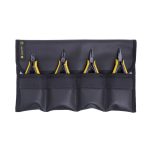 Pliers and hand tools
Matching flat-nose, needle-nose and side cutters for the electronics bench.
View productsWhat to look for in material, jaws and grip?
The key points are hardened steel, cleanly ground round jaws without burrs, and a joint that runs tight and without play. A spring-loaded joint opens the pliers on its own and relieves the hand during many bends.
- Jaws: fully round and polished so the wire is not marked.
- Tip: slim enough for the smallest loop you need.
- Joint: play-free, hardened, ideally with a return spring.
- Handles: ergonomic, and dissipative ESD grips for electronics.
- At the electronics bench avoid magnetised jaws.
For the ESD workstation choose models with dissipative grips so no charge builds up on the tool. Also look for a comfortable handle length and low weight if you form many loops over a long shift.
Frequently asked questions
What are round-nose pliers for?
For bending wire into round shapes such as loops, coils and rings. The two conical jaws create a defined radius without kinking or marking the wire.
Which jaw diameter suits my wire?
Fine wire of 0.3 to 0.6 mm is bent near the tip at 1 to 2 mm, wire up to 1.5 mm rather at the wider base at 3 to 4 mm. The position on the jaw sets the loop radius.
Can round-nose pliers cut?
No. Round-nose pliers have no cutting edge. Trim the wire first with a side cutter, then form the loop with the round-nose pliers.
How do they differ from needle-nose pliers?
Needle-nose pliers have flat, often serrated jaws for gripping and holding. Round-nose pliers have round, smooth jaws used only to form curves and loops.
Looking for the right round-nose pliers?
We supply round-nose pliers with polished jaws and dissipative ESD grips for clean loops and bending work at the electronics bench.
Precise jaws
Round, polished jaws for mark-free loops.
ESD-ready
Models with dissipative grips for the electronics bench.
Proven quality
Hardened steel and a play-free joint.
Selection help
We help you choose the right products; technical details are clarified with the manufacturer.